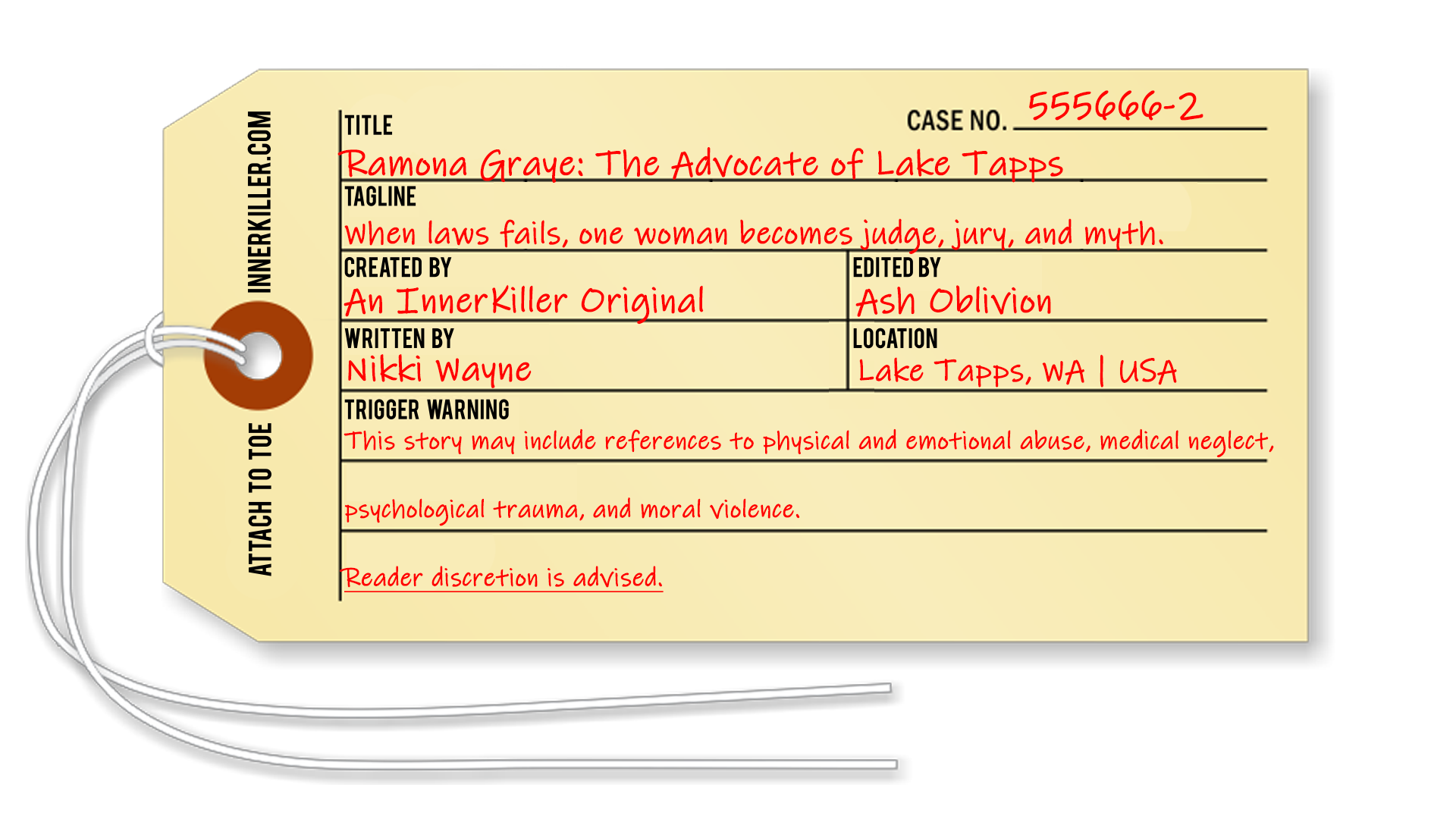
The Advocate of Lake Tapps
Originally submitted as an iKProfile, Ramona Graye’s serial killer profile outlined a revenge-driven vigilante who preys on abusive caregivers, a mind teetering between justice and obsession. Read Her Story →
INNER KILLER'S ORIGINS AND IDENTITY
What's her first and last name? Ramona Graye
Does she have any nickname(s) or alias? “The Advocate” | Some call her “The Sister” in whispered rumors across care facilities.
How old is she, and where is she originally from? 37 years old, born and raised in Lake Tapps, Washington.
When and where does this story unfold? Set in the Pacific Northwest in the 2020s. The story unfolds in a post-pandemic society where understaffed social services and overwhelmed caretakers leave the vulnerable at risk.
Describe her appearance in 3 words: Sturdy, maternal, unassuming.
What was her childhood like? Ramona was the oldest sibling in a fractured household. Her parents struggled with substance abuse, forcing her to grow up fast. She became the de facto caregiver to her younger sister, Lily, who was born with severe cognitive impairments. Their bond was unbreakable. Ramona was always protective and had no room for childhood joys—just survival.
What relationships does she value most, if any? Her sister, Lily, is her entire world. Ramona never married, never dated seriously, and never moved far from home. Lily is her anchor, her reason, her weak spot—and her fury.
What is her "normal" life like, including her hobbies, passions, and work? Ramona works part-time at a local hardware store and volunteers with organizations that advocate for the elderly and people with disabilities. She enjoys DIY carpentry, survivalist forums, and tending to a modest greenhouse in her backyard. She leads a simple, private life—but always keeps her eyes open for signs of abuse.
MOTIVATIONS AND TURNING POINTS
What event or moment awakened her "Inner Killer"? When Ramona secretly installed a nanny cam and discovered Lily’s caretaker duct-taping her sister to a chair, berating her, and laughing while using her house for selling stolen prescriptions—something inside Ramona broke. Not just the rage, but the clarity that no one would protect Lily if she didn’t.
What’s her ultimate goal or driving force? To expose, dismantle, and destroy anyone who harms the most vulnerable—especially under the guise of caregiving. She views herself as a necessary force in a broken system, doing what social services can't or won't.
What was the first violent or rebellious act she committed? She sedated the caretaker with her own stolen pills, suspended her upside down in the tool shed, and handed Lily a child-sized bat. What followed wasn’t rage—it was methodical, cleansing. And it wasn’t murder in her eyes—it was justice.
METHODS, ACTIONS, SYMBOLISM, AND CRIMES
Who are her victims, and why does she choose them? She targets caregivers, nurses, home health aides, and even social workers who exploit or abuse their patients—especially those with cognitive or physical impairments. She selects them through online forums, news clippings, whispered rumors in advocacy groups, and firsthand surveillance.
How does she carry out her killings, and what weapon(s) or methods does she use? Ramona abducts her victims under the pretense of evaluating their caregiving services. She uses tranquilizers or gas to subdue them, then stages elaborate revenge "therapies" involving the abused victim when possible. Her favorite tool: a Louisville slugger wrapped in rainbow grip tape—symbolic of her sister’s favorite colors.
Does she have a signature or ritual that ties her crimes together? Yes—each victim is found strung up or restrained, often with the same industrial-strength duct tape used on her sister. A toy or symbol belonging to the abused individual is always left at the scene, along with a simple index card reading: “Caretaker. You were trusted.”
THE INNER STRUGGLE WITH PSYCHOLOGY
How does she feel before, during, and after her crimes? Before: Focused and calm, like a surgeon preparing for a life-saving operation. | During: Alert, commanding, sometimes cold. Occasionally emotional, depending on the victim. | After: A strange blend of exhaustion, peace, and readiness to do it again. She doesn’t feel guilt—only vindication.
What mental health challenges or struggles drive her? She shows signs of Complex PTSD, rooted in childhood trauma and caregiver fatigue. Her moral rigidity borders on obsessive-compulsive personality disorder. She also exhibits dissociation when processing the violence, which she reframes as acts of justice.
What is her greatest fear or vulnerability? That Lily will be institutionalized or harmed again. Her entire system of control would collapse if something happened to her sister. The mere thought sends her into panic. Also, if Lily were to understand what Ramona has done and reject her, it would destroy her.
CONFLICT, CONSEQUENCES, AND RESOLUTION
How does she avoid getting caught, and what would be her reaction if confronted? She avoids detection by working off-grid, using burner phones, disguises, and stolen identities. She often frames others or creates evidence trails that point to unrelated criminal activity. If confronted, she would not run—she’d likely try to recruit the interrogator to her cause, or go down in a blaze of justified rage.
What would it take for her to stop? Only one thing: Lily’s death. Without her sister, Ramona would no longer have a reason to carry on—her mission, her vengeance, her very identity are rooted in Lily’s wellbeing.
Are there any partners in crime or a solo act? Primarily solo, but Lily, unknowingly, has been part of one kill. Ramona occasionally manipulates victims own patients to assist in poetic justice—but never in ways they would fully comprehend.
OPTIONAL CREATIVE EXPLORATION, IMAGINATION, AND EMOTIONAL RESONANCE
What societal issues or injustices does her story expose? The rampant neglect in elder and disability care. Systemic underfunding of support services. Abuse of power within caregiver roles. The invisibility of victims who cannot advocate for themselves.
How does her story reflect the struggles women face today? Ramona’s story is about invisible labor—women being expected to give without breaking endlessly. It’s about being the only line of defense in a system that fails everyone but punishes those who protect it. It’s about rage, justice, and consequence.
What does her ultimate end look like? Her final act may be one of tragic sacrifice—possibly surrendering herself to save Lily from being institutionalized. Becoming a legend immortalized in the care community: the angel of mercy—or vengeance.
Is there anything else you'd like to add? This killer isn’t just scary—she’s sad, righteous, and painfully human. That’s what makes her unforgettable.