Psychotic vs. Sociopathic
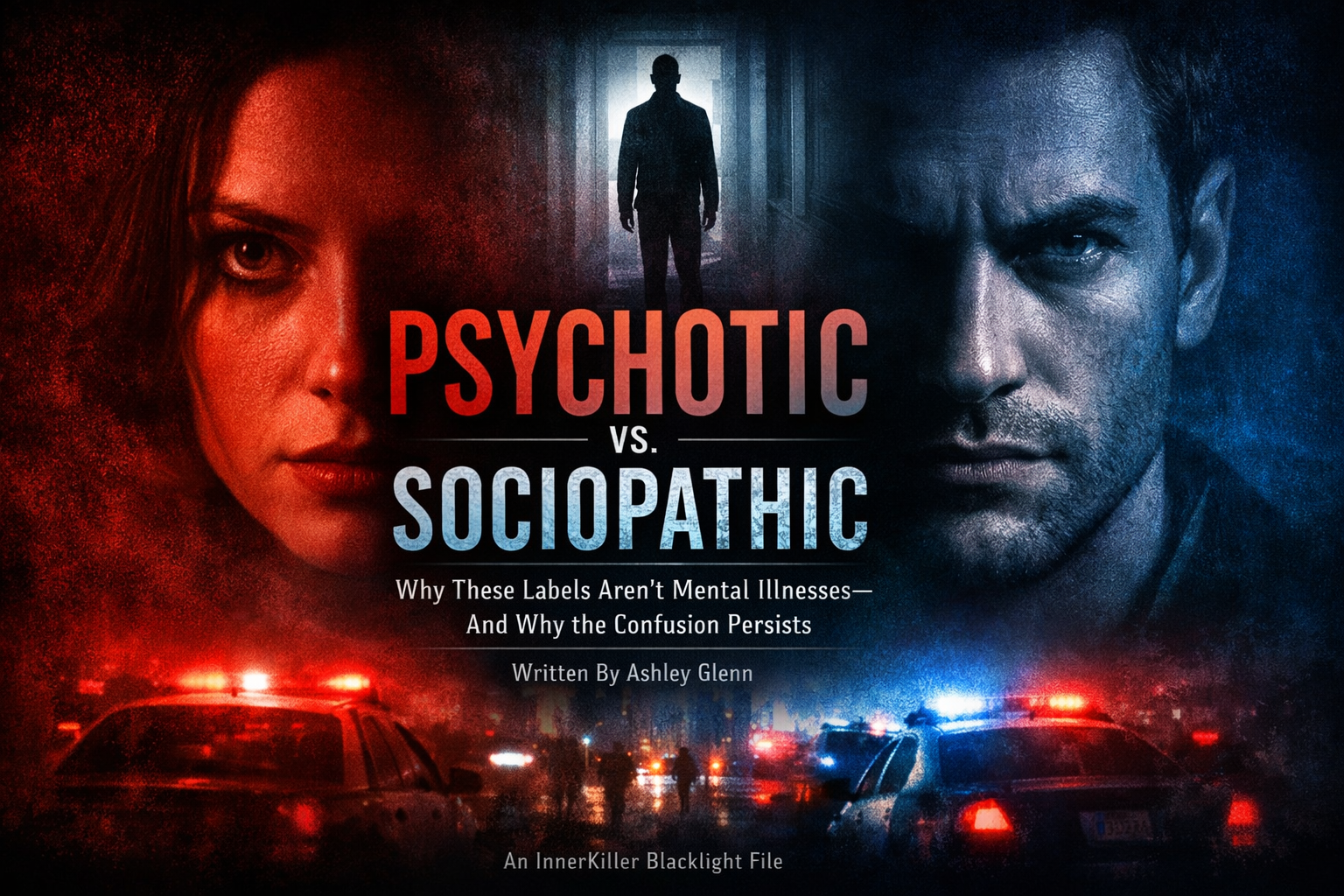
Some words feel diagnostic even when they are not. Psychotic.Sociopathic.
They arrive already carrying fear, certainty, and an implied verdict.
In crime media, in headlines, and in everyday conversation, these terms are often used as moral shortcuts, ways to explain violence without sitting with its complexity. But when examined under steady light, neither word functions the way the public believes it does. And neither, on its own, represents a mental illness in the way anxiety, depression, or schizophrenia do.
Understanding the difference matters, not to excuse harm, but to prevent misunderstanding from becoming its own kind of damage.
Psychotic Is Not a Personality
Psychosis is a state, not a character type. It refers to a temporary or ongoing condition in which a person’s perception of reality becomes altered through hallucinations, delusions, or disorganized thinking. Psychosis can occur in many contexts: severe stress, trauma, sleep deprivation, substance use, mood disorders, or neurological illness.
It does not inherently involve violence.
It does not imply a lack of empathy.
And it does not describe who someone is.
Yet culturally, “psychotic” has been flattened into a synonym for unpredictability and danger. This distortion matters because it quietly teaches the public to fear people experiencing psychiatric crises rather than understand them. Psychosis becomes framed as a moral failure instead of a human vulnerability.
In reality, most people who experience psychosis are far more likely to be harmed than to harm others.
Sociopathic Is Not a Diagnosis
“Sociopath” is not a formal clinical diagnosis. It is a colloquial term, historically used to describe patterns now more precisely discussed under antisocial personality traits or disorders. Even then, these traits exist on a spectrum and must be evaluated in context.
Sociopathy does not mean someone is incapable of feeling.
It does not mean someone is automatically violent.
It does not mean someone lacks all moral reasoning.
What it often imprecisely describes is a pattern of learned emotional detachment, impaired accountability, or rule-breaking behavior shaped by environment, development, and survival strategies. Many of these traits emerge in response to chronic instability, neglect, or trauma, not as evidence of an inborn moral void.
When “sociopath” is used casually, it collapses behavior, motive, and identity into a single word. That collapse is not neutral. It strips complexity from human development and replaces it with fear-based shorthand.
Why Neither Term Equals “Mental Illness”
Psychosis is a symptom cluster.
Sociopathy is a cultural label.
Neither operates as a standalone mental illness in the way public language suggests. But crime media often treat them as final explanations, endpoints that relieve the audience of further questioning.
This framing creates two harms at once:
It stigmatizes mental health conditions by linking them reflexively to violence.
It obscures the social, developmental, and situational factors that actually shape harmful behavior.
When every act of violence is attributed to “a psychotic break” or “a sociopath,” systems, environments, and failures of care disappear from the conversation. Responsibility becomes individualized in the most reductive way possible.
Curiosity Without Collapse
It is not wrong to want language for understanding disturbing behavior. Curiosity is human. But there is a difference between seeking clarity and seeking containment, between understanding and naming something so we no longer have to look at it.
Labels feel stabilizing. They give fear a container.
But when used without precision, they replace inquiry with illusion.
The truth is quieter and more unsettling: human behavior is rarely explained by a single word. Violence, when it occurs, emerges from intersections of trauma, belief, opportunity, power, and context. No label removes that complexity.
Under the Blacklight
Blacklight Files exists to slow the reflex to simplify. To examine not just what words mean, but how they are used—and what they protect us from having to confront.
Psychotic and sociopathic are not diagnoses to be applied at a distance. They are signals of how desperately we want certainty in the face of fear.
Understanding begins when we stop treating language as a verdict and start treating it as a lens, one that must be adjusted carefully, or it distorts more than it reveals.
The file closes here, not with answers, but with a steadier frame. The darkness does not need exaggeration to be understood. It only needs light that does not flinch.