What Makes a Killer’s Psychology Believable?
A Forensic Guide for iKWriters
Some killers feel real.
Some feel written.
And readers know the difference in one heartbeat.
Inside the InnerKiller universe, psychological realism is everything. A character’s darkness doesn’t need to be polite, palatable, or even rational — But it does need to make sense.
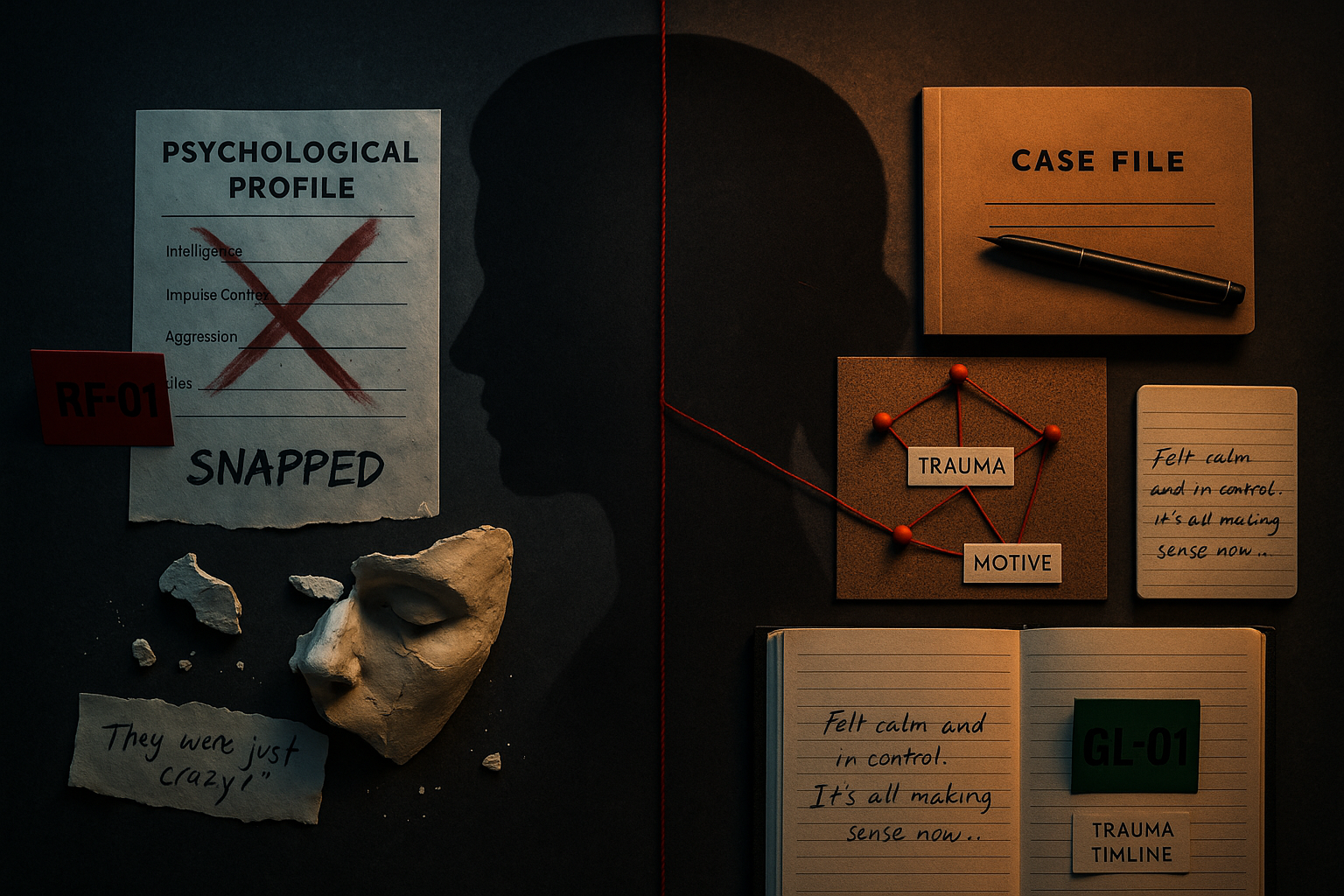
This guide helps you spot the Green Lights (behaviors that feel grounded, compelling, and psychologically true) and the Red Flags (choices that snap a reader out of the story because they feel forced, cliché, or “author-manufactured”).
Think of this as your writer’s forensic manual.
GREEN LIGHTS: Signs Your Killer Feels Real, Not Random
🟢 1. A Clear Internal Logic (Even If It’s Twisted)
Your killer doesn’t need a healthy worldview—just a consistent one.
Readers don’t have to agree with her beliefs, but they should recognize the pattern.
Green Light Examples:
Her murders follow a recognizable emotional trigger.
Her rituals echo her trauma or worldview.
Her choices reflect her values, no matter how warped.
A killer with rules—even broken ones—feels real.
🟢 2. Trauma That Shapes, Not Excuses
Trauma doesn’t “explain away” her violence — it informs her patterns, reactions, fears, and hunting style.
Readers accept:
Trauma → coping mechanism → distorted evolution → signature behavior.
They reject:
“Her dad was mean, so she became a killer lol.”
Give trauma weight. Not shortcuts.
🟢 3. Emotional Truth > Clinical Accuracy
You don’t need a degree in psychology.
You need emotional realism.
Readers respond to:
The way anger tightens her jaw.
The way rejection twists her logic.
The way shame mutates into grandiosity.
If the emotion feels true, the psychology feels real.
🟢 4. A Strong POV Lens
If we can see the world through her eyes, everything makes sense—even the senseless.
Show us:
Her rationalizations
Her blind spots
Her misconceptions
Her internal debates
Her moments of clarity, cruelty, or softness
The killer becomes believable when her reality becomes ours.
🟢 5. Behaviors That Match Her Skillset
A nurse who knows how to titrate morphine? Believable.
A suburban mom hacking military-grade servers? Maybe not.
Readers love:
Killers who use what they already know
Killers whose murders reflect their environments
Killers whose “genius” feels earned, not gifted
Authenticity > invincibility.
RED FLAGS: Signs Your Killer Feels Fake or “Written”
🔴 1. She’s Good at Everything
The omnipotent killer is a red flag. Skills should come from somewhere—career, trauma, environment, obsession—not writer convenience.
Avoid:
Expert fighter + hacker + chemist + master seductress + psychic trauma ninja.
Unless she’s secretly five people, pick a lane.
🔴 2. Motivations That Flip Like a Light Switch
Readers reject:
Sudden personality changes for plot convenience
Motivations that contradict her psychology
Emotional shifts with no buildup
No killer changes without pressure, consequence, or rupture.
🔴 3. Clichés Used Without Depth
Clichés aren’t bad. Empty clichés are.
Examples readers roll their eyes at:
“She was just jealous.”
“She loved killing for fun.”
“She snapped.”
These can work—but only if deeply explored:
What does jealousy represent?
What need does killing meet?
What caused the snap?
Don’t rely on tropes. Dig into the marrow.
🔴 4. Convenience Over Consequence
Readers hate when the universe bends to help the killer.
Red Flags:
Instantly disposing of bodies with no tension
Never making mistakes
Always finding the “perfect” victim at the perfect time
Coincidences replacing strategy
Even the smartest killers bleed somewhere.
🔴 5. Trauma Presented as a Superpower
Yes, trauma shapes killers.
No, trauma does not instantly turn them into elite masterminds.
Avoid:
“She was abused, so now she’s unstoppable.”
“Her DID gives her ninja abilities.”
“Her anxiety makes her psychic.”
Trauma can fuel a character — but it should never turn into a magic trick.
WHAT READERS ACCEPT 🟢
Readers are willing to embrace:
Dark logic
Distorted realities
Emotional imbalance
Moral collapse
Trauma-based behavior
High skill in one or two domains
A signature style or ritual
Intensity, obsession, and irrational thinking
As long as it has roots.
WHAT READERS REJECT 🔴
Readers instantly reject:
A killer with no believable psychology
A killer who only exists to serve the plot
A killer who behaves differently scene-to-scene
A killer who is “evil because evil.”
Trauma is treated like an on/off switch
Unrealistic policing, forensics, or body disposal
Coincidence-driven kills
In other words, they reject anything that feels cheap.
THE GOLDEN RULE
A killer can be extreme.
A killer can be unhinged.
A killer can be supernatural in her confidence, charisma, or cruelty.
But she cannot be empty.
If readers understand why she kills, they will follow her anywhere.
If they don’t, the illusion breaks.
Your job, iKWriter, is to build killers with roots deep enough that everything growing from them feels inevitable — even if horrific.