When Persistence Becomes Permission: Cultural Scripts That Rebrand Stalking as Devotion
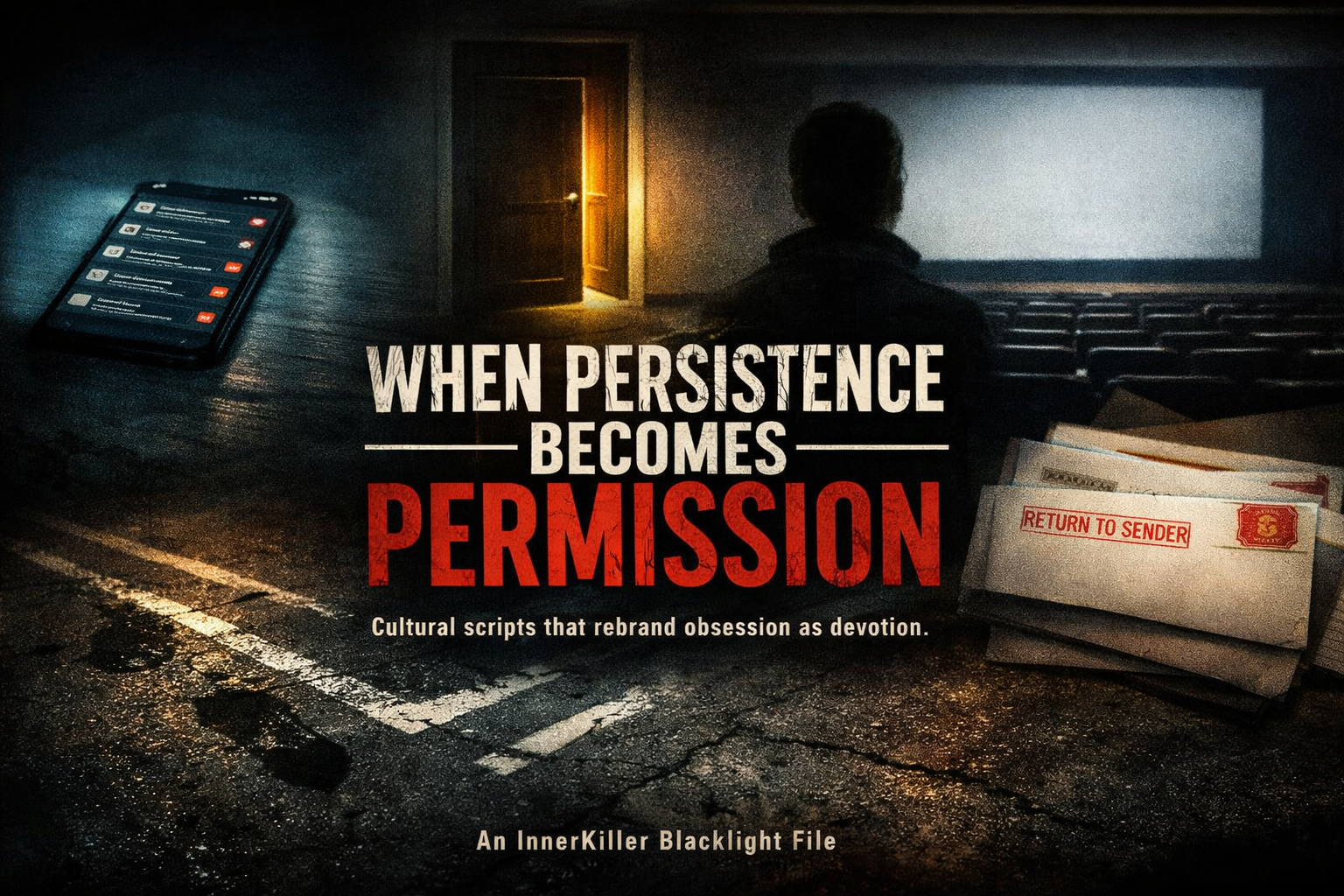
There is a particular story culture loves to tell about pursuit.
It sounds romantic. Determined. Earnest. Someone refuses to give up, refuses to take no for an answer, refuses to walk away because the feeling is “too real” to abandon. In these stories, persistence is framed as a virtue, and resistance is positioned as temporary confusion rather than a boundary.
Under steady light, this narrative becomes less tender and more troubling.
Stalking does not begin with menace. It often begins with meaning. The belief that wanting someone deeply enough grants moral permission to continue reaching for them, even after they have said no. Culture does not invent this belief, but it rehearses it—over and over—until it feels familiar, even benign.
Movies teach us that refusal is a test.
Music teaches us that longing justifies intrusion.
Social narratives teach us that “giving up” is weakness, while endurance proves sincerity.
These scripts do not instruct people to stalk. They do something quieter. They blur the line where consent should end the story.
Persistence as a Moral Performance
In many cultural narratives, pursuit is framed not as behavior but as character. The one who keeps trying is depicted as loyal, brave, and emotionally invested. Their persistence becomes evidence of goodness rather than a choice that affects another person.
What disappears in this framing is impact.
When persistence is elevated to a moral quality, the experience of the person being pursued becomes secondary—or invisible. Their discomfort is rewritten as mixed signals. Their boundaries are reframed as fear of vulnerability. Their autonomy becomes a puzzle to solve rather than a decision to respect.
This is not an accident of storytelling. It reflects a deeper discomfort with finality. A no that cannot be negotiated forces an ending, and many cultural forms are resistant to endings that don’t reward effort.
The Romance of Override
One of the most enduring myths in romantic media is that true connection requires override. That love is proven by the willingness to push past obstacles: distance, silence, rejection. The obstacle itself becomes romanticized, while the ethical question of consent recedes.
In these stories, the pursued person is often static. Their internal world is unexplored. Their refusal exists only to be overcome. Persistence is validated by outcome—if the story ends in togetherness, all prior discomfort is retroactively justified.
This retrospective logic is dangerous. It teaches that outcomes can erase process. That if someone eventually relents—or is worn down—the earlier violation doesn’t count.
In real life, consent is not a plot device. It does not exist to heighten tension. It is not provisional.
When Devotion Masks Control
Another cultural script frames relentless attention as care. Knowing someone’s routines. Showing up uninvited “just to make sure they’re okay.” Monitoring disguised as concern.
These behaviors are often presented as protective or attentive, especially when enacted by characters coded as emotionally wounded, misunderstood, or passionately attached. The narrative encourages empathy for the pursuer while quietly normalizing surveillance.
What gets lost is proportion.
Care responds to expressed need. Control anticipates, assumes, and overrides. When cultural narratives blur this distinction, they create emotional cover for behavior that would otherwise register as invasive.
This does not mean every depiction of longing is harmful. But repeated exposure to stories that reward boundary-crossing trains audiences to see discomfort as temporary friction rather than meaningful data.
Gendered Scripts, Uneven Consequences
These narratives do not land evenly.
Historically, persistence has been gender-coded as a masculine virtue and feminine resistance as flirtation or uncertainty. While these dynamics are evolving, their residue remains embedded in storytelling traditions. Refusal is still too often treated as ambiguous when it comes from women, and pursuit is still framed as admirable when enacted by men.
This framing has consequences beyond miscommunication. It shapes whose fear is believed, whose boundaries are taken seriously, and whose behavior is excused as “romantic” rather than recognized as coercive.
Importantly, none of this requires malicious intent. Cultural scripts are powerful precisely because they operate without conscious endorsement. People absorb them long before they question them.
Curiosity Without Endorsement
Examining these narratives does not mean condemning all romantic media or pathologizing desire. Curiosity about obsession, longing, and attachment is human. Storytelling has always explored these states.
The ethical distinction lies in framing.
When stories illuminate the internal cost of pursuit—on both sides—they create understanding. When they obscure consent, flatten resistance, or reward override, they create confusion, not excitement, but miseducation.
Blacklight Files exist in this space: not to shame, but to clarify. Not to sensationalize harm, but to examine how it is normalized.
Rewriting the Script Under Steady Light
Cultural narratives do not force behavior, but they do shape the stories people tell themselves about what behavior means. When persistence is framed as love, stopping feels like failure. When refusal is framed as ambiguity, listening feels optional.
Illuminating these scripts does not end them. But it gives readers language. And language creates distance—the space where reflection becomes possible.
Under steady light, devotion no longer needs to chase.
Consent no longer needs to be tested.
And endings can exist without being framed as loss.
Not every story needs to have a resolution. Some truths need to be seen clearly, and then left to sit quietly, honestly, without applause.