Across the Glass: What Interviewing Convicted Serial Killers Reveals, and What It Cannot
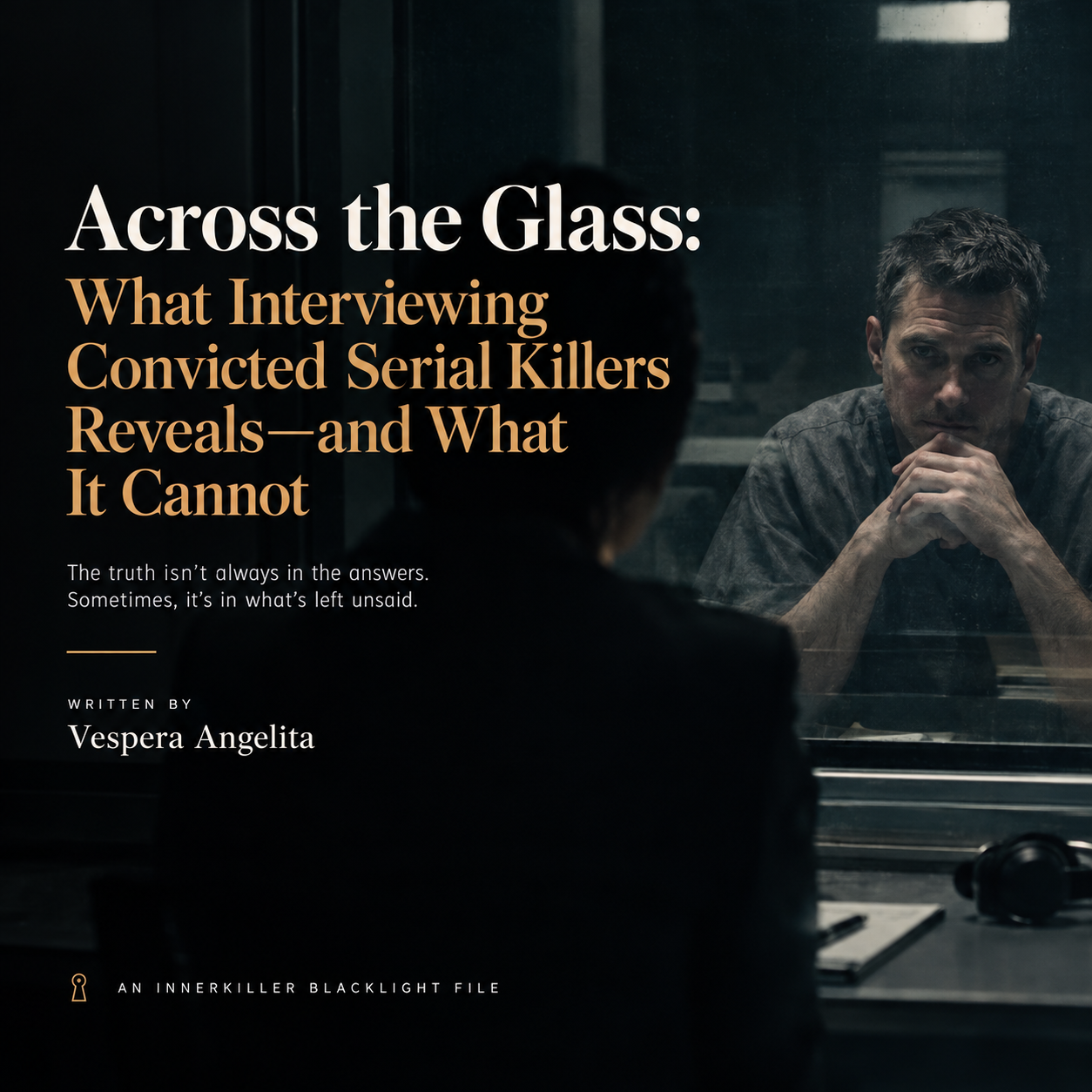
Interviewing convicted serial killers has become one of the most recognizable rituals in modern true crime culture.
The setting is familiar: a controlled room, a restrained voice, a person whose actions have already crossed an irreversible line. The promise is insight—an opportunity to understand how such harm occurs, how a person arrives there, and whether clarity can be extracted from proximity.
What is less often examined is what these interviews actually measure. Not truth, necessarily. Not motive in any clean sense. More often, they reveal how meaning is constructed after harm—by institutions, by audiences, and by the speaker themselves.
The Illusion of Access
Interviews suggest access. A chair across the table implies proximity to answers that feel otherwise unreachable. But access is not the same as understanding. By the time an interview occurs, the subject is already embedded in a new context: incarceration, notoriety, and repeated retelling. Memory has been rehearsed. Language has been refined.
What emerges is not a raw interior life but a narrative shaped by survival, control, and audience awareness. This does not make interviews useless—but it does make them limited. They show how a person wants to be understood now, not necessarily how harm unfolded then.
Narrative as Containment
For many convicted offenders, interviews become a form of containment. The story is bordered. The questions are predictable. The answers, over time, become smoother. This is not manipulation in a theatrical sense; it is adaptation. Humans adjust to their environments, even extreme ones.
The danger lies in mistaking coherence for causation. A clean explanation can feel satisfying, especially when the acts themselves resist comprehension. But violence rarely follows a single thread. When an interview compresses years of behavior into a digestible arc, complexity is not clarified—it is reduced.
The Listener’s Role
Interviews are not neutral exchanges. They are relational events. The interviewer brings expectations, frameworks, and cultural narratives into the room. So does the audience. Curiosity is not passive; it exerts pressure.
When viewers or readers seek “the moment it clicked” or “the reason why,” they often overlook what the interview truly documents: how people perform meaning under observation. This performance can be unsettling precisely because it is calm, articulate, and familiar.
That discomfort is worth noticing. It reminds us that harm does not require spectacle to exist—and that understanding should not be confused with identification.
Ethics Beyond Exposure
There is an assumption that more exposure leads to more prevention. The reality is less certain. Interviews can educate, but they can also distort by centering the voice of the person who caused harm while relegating impact to the margins.
A trauma-aware approach does not forbid examination. It asks for proportion. Who is being illuminated, and at whose expense? What context is provided alongside the voice speaking? What boundaries are maintained?
Ethical distance is not avoidance. It is structure. It allows learning without collapse, curiosity without absorption.
What Interviews Can Offer—Carefully
At their best, interviews reveal the limits of explanation. They show how people rationalize, fragment, and narrate themselves under scrutiny. They expose the gap between action and account.
For researchers, clinicians, and careful readers, this gap is instructive. It cautions against overconfidence. It underscores the importance of systems, environments, and cumulative harm rather than singular causes.
Closing Reflection
Interviewing convicted serial killers does not open a window into evil so much as it holds up a mirror to our expectations of understanding. What we see reflected there—clarity, discomfort, restraint—depends on how steadily we hold the light.
The value is not in getting closer. It is in seeing clearly, then stepping back, carrying insight without carrying the story any further than it needs to go.