The Velvet Widow
⚠️ Trigger Warning:
This story may include references to physical and domestic harm, sexual violence, psychological trauma, moral corruption, and death by poisoning.
Reader discretion is advised.
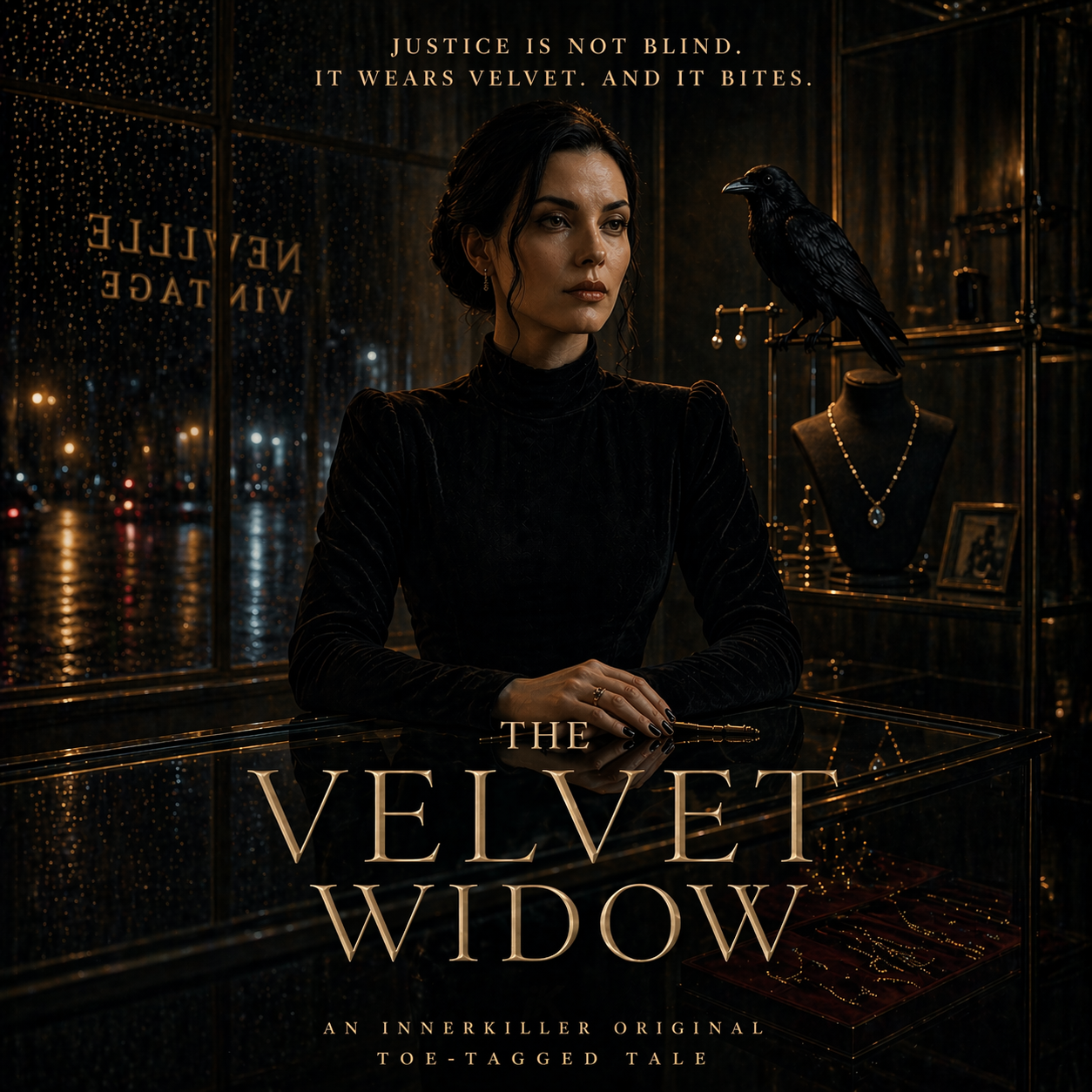
Chapter 1 — Velvet in the Stormlight
The feather did not belong inside the boutique. It found its way there anyway.
I noticed it before the door chimed, before the street noise slipped in with the damp heat. It rested on the glass counter like something that had made a decision. Not fallen. Not drifted. Decided. I picked it up and rolled the stem between my fingers.
It felt warmer than it should have, as if someone had held it before me. Poe watched from the curtain rod near the back room, his head tilted just enough to look like judgment instead of curiosity. I told him he had brought it in. He clicked his beak once, which was not an answer. It never is.
The door opened with the small, polite chime I chose because it sounded harmless. People trust harmless sounds. A man stepped inside, bringing the smell of wet pavement and something sour beneath it, like old anger that had learned to behave in public. Mr. Tully smiled in a way that assumed I would smile back.
I did.
“Mr. Tully,” I said. “You are early.”
He shrugged out of his damp jacket and looked around like he owned the room. He did not, but men like him practice ownership until it fits. His eyes lingered on the velvet trays, the glass cases, and the things made to be touched carefully. He told me I ran a pretty place and that it would be a shame if something happened to it.
I placed the feather beneath the counter and folded my hands over the glass. My reflection hovered faintly there, soft, well-lit, and his stood beside mine, heavier, less careful with the light. I told him I insured everything.
“That is smart,” he said. “Because insurance pays out. Not everything else does.”
His smile was practiced, like the rest of him. I watched his mouth instead of his eyes because mouths tell the truth faster. He said he had come about the rent. He called it adjustments, as if a kinder word could make theft more respectable.
“Neighborhood is changing,” he said. “Property values go up. You understand.”
I understood patterns. I understood how men decided what they were allowed to take. I understood the way their voices softened when they said something sharp. I told him he had signed a contract.
He leaned forward and placed both hands on the counter. His fingers were thick and clean, with nails trimmed too short. They were the kind of hands that break things by accident and call it circumstance. “Contracts can change,” he said. “Or places can close.”
Behind him, the door glass held a reflection of the street. A woman passed by with an umbrella too bright for the sky, and the color pulled at something in me. Water moving too fast. A hand slipping. My mother’s voice cut short. I blinked, and the street returned to itself.
I told him other tenants had complained. His mouth twitched, just slightly. There it was. Not guilt, but irritation.
“People complain,” he said. “That is what they do when they cannot afford things.”
“Or when they are afraid,” I said.
He laughed, low and dismissive. “Afraid of what? Me?”
I did not answer immediately. Silence can behave like a blade if you hold it correctly. I let it sit between us until he became aware of it. Then I told him he could answer that for himself.
His eyes flickered across my face, searching for something useful. I gave him the version of me that always works. Calm, polite, and a little distant. The kind of woman men think they can adjust.
“You are doing well here,” he said, softening again. “It would be a shame to lose it over something small.”
Small. The word landed wrong. It always does.
There are men who believe harm is measured by volume. If it is quiet, it is small. If it leaves no mark, it did not happen. I told him I was not concerned about small things, and he leaned closer as if we were sharing something intimate.
“You should be,” he said.
Poe shifted above us, claws scratching lightly against the rod. Mr. Tully glanced up and asked whether I kept that thing inside. I told him Poe stayed where he was safe. For a moment, something unguarded crossed Mr. Tully’s face, not fear, but recognition of something he could not name.
“Birds carry disease,” he said.
“So do people,” I said.
The silence changed after that. It thickened. He straightened and pulled his hands back from the glass. He told me to think about what he had said because he would be back next week.
I nodded. “Of course.”
He turned toward the door, pausing only long enough to look over his shoulder. “Pretty place,” he said again. “Would be a shame.”
The chime sounded as he left, soft and harmless.
I stood still until the sound settled. Then I reached beneath the counter and brought the feather back into the light. It looked darker now, though the lighting had not changed. Poe dropped down to the edge of the counter and watched me with that sideways stare.
“He thinks it is small,” I said.
Poe clicked his beak again.
I turned the feather between my fingers and imagined how it would look against skin. Not his face. Never the face. Somewhere quieter. Somewhere that would take longer to understand what was happening. The thought did not feel sudden.
It felt familiar, like a room I had already walked through and left open behind me. I set the feather down carefully, aligning it with the edge of the glass. Straight. Intentional. Outside, thunder rolled somewhere far off, too early for the storm to arrive.
It would come anyway.
I reached up and slid the hairpin loose from my hair, just to feel the weight of it in my hand.
Chapter 2 — The First Feather
Mr. Tully came back before the storm did, which felt like arrogance. Even the sky had enough decency to gather itself first.
I saw him through the front window, pausing beneath the awning with his phone pressed to his ear. His lips moved around my name. Macee Neville looked careless in his mouth, like another thing he could raise the price on. I stayed behind the counter and watched him finish, pretending the call mattered.
Poe sat above me on the curtain rod with his feathers tucked close. The black feather remained where I had placed it the day before, aligned with the glass edge and disciplined into silence. The boutique smelled of cedar, velvet, and rain pushing through old brick. I had brewed tea because women who brew tea are rarely accused of anything interesting.
I had polished the silver tray twice, although it had not needed polishing the second time. The hairpin rested beside the teacups. It looked delicate there, almost decorative. It looked like a thing meant to hold softness in place.
The door chimed, and Mr. Tully entered without asking whether I was open. When he asked if I was busy, I told him I wasn't. He liked that because men like him mistake controlled access for surrender. He removed his hat and shook water onto my floor, not much, just enough to make sure I saw.
“I talked to my attorney,” he said. “You are not as protected as you think.”
“I thought you came to talk about rent.”
“I came to talk about reality.”
He stepped farther inside and inspected the room again. His gaze moved over antique mirrors, lace gloves, and velvet jackets arranged by color. He touched a mourning brooch without permission, rubbing his thumb across the black enamel. When I told him my mother had worn one like it, he pulled his hand back, but not because he was sorry.
“Sentimental inventory,” he said. “That must sell well down here.”
Something small and hot opened beneath my ribs. It was not rage, because rage is too generous a word for what he touched. This was older than anger and less clean. I poured the tea before my face could betray me.
“You take sugar?” I asked.
“You trying to sweeten me up?”
“I would not know where to begin.”
That made him pause, and I saw it before he repaired himself. His smile thinned, then returned with a little more tooth. He told me I was cute when I thought I was sharp. I set his cup on the counter and felt disappointed that my fingers did not shake.
Mr. Tully drank before I did. He burned his tongue and cursed under his breath, then looked at me as if the heat had been my insult. He said I would have thirty days unless I came up with something better. When I asked if he meant better than money, he leaned on the counter and smiled.
“You are a smart woman,” he said.
Poe shifted above us, and one claw scraped wood. Mr. Tully glanced up and said the bird gave him the creeps. I told him Poe had good instincts. He called Poe ugly, and I said some truths were ugly too.
He stared at me then, deciding whether to laugh or hurt me. I could see the little calculation moving in his face. It was almost tender, the way violence announced itself before pretending it had been provoked. Then he told me I should be careful.
The words passed through me and struck somewhere flooded. I saw water climbing stairs. I saw my mother’s hand reaching back, not for help, but to push me higher. I heard a man shouting over the wind, not afraid enough and never sorry enough.
I picked up my own cup and did not drink. I asked what he had said, although I had heard every word. He smiled and repeated himself. Careful, he said, as if the word belonged to him.
Women are trained on that word until it becomes a room with no windows. Be careful walking home. Be careful smiling. Be careful saying no. Be careful, surviving men who later describe themselves as misunderstood.
He took another drink, and this time he swallowed more deeply. The toxin did not announce itself. That was the beautiful part, or maybe the unforgivable part. It entered like manners, quiet and precise and already committed.
Mr. Tully wiped his mouth with the back of his hand. He told me someone knew he had come here, and his cousin handled his books. I told him that sounded responsible. He leaned closer and said it meant I should not get clever.
I looked down at the feather. It had shifted slightly, though neither of us had touched it. Poe clicked his beak once. Mr. Tully frowned and asked what was wrong with that thing, then corrected himself when he realized he meant his own body.
His hand went to his throat. He tried to swallow again, but his body had begun refusing ordinary instructions. Confusion came first. Men always look offended before they look frightened, as if death is poor service.
I came around the counter slowly and told him to sit down. He grabbed the edge of the glass, knocking the teacup sideways. It rolled once and broke against the floor. Tea spread into the cracks between the boards, dark and hot, like the room had opened a vein.
“What did you do?” he asked.
I caught his elbow before he fell. I did not do it kindly. I did it efficiently. His weight surprised me, although it should not have. Harm always becomes heavier when it needs to be carried.
“You came to talk about reality,” I said.
His knees buckled, and I lowered him behind the counter, away from the front window. His face had gone damp, and his eyes were wide with furious disbelief. He rasped for help, and for one brief second, I almost gave it. I would hate that later, not because mercy came, but because it came late and small.
Then his hand closed around my wrist.
I looked at his fingers on my skin. I thought of every woman who had mistaken a locked grip for fate. I thought of water. I thought of my mother pushing me upward while the world took her under.
“No,” I said.
The word settled him more than the poison did. His mouth moved, but the sound broke apart before it became language. His body fought, then weakened, then gave itself over with an ugly little shudder. When it was done, the boutique felt too quiet.
I stood there holding my wrist where his fingers had been. Five red marks rose slowly, blooming with proof. Poe hopped down to the counter and lowered his head toward the feather. I picked it up before he could touch it.
For a while, I only held it. There was still time not to make it mean anything. There was still time to clean, to panic, to call this an accident, a defense or some terrible weather inside my head. I knelt beside Mr. Tully instead.
His hand lay open, palm up, as if he expected something to be given back. I placed the feather beside it, close but not touching. My own hand hovered after I let go. The feather landed softer than breath, and it looked like it had been waiting years to fall.
Chapter 3 — Courtroom Ghosts
By morning, the city had already begun lying about Mr. Tully. Men become softer in public after they die. The article called him a local property owner, not a man who pressed women into corners with paperwork and smiled as their choices shrank. It did not mention my wrist, where his fingers had left five fading marks I covered with a silk bracelet before opening the boutique.
I read the headline twice, then folded the paper into neat quarters. Poe watched from the back counter with his head tucked low, as if he understood print better than people. The feather was gone from Mr. Tully’s hand by then, of course. Evidence disappears when someone understands what it means.
The courthouse charity luncheon began at noon, and I attended because Judge Malcolm Duret had ordered a pair of vintage cufflinks from me. Gold, engraved, dignified in the way expensive objects become when they have survived worse men than the ones wearing them. I wrapped them in black tissue and tied the box with velvet ribbon. Presentation matters when offering a man the smallest piece of his own ending.
The courthouse smelled of marble dust, lemon polish, and wet wool. The lobby shadows stretched beneath the tall windows in long gray bands, crossing the floor like bars that had given up pretending to hold anyone. Judge Duret stood near the center of the room while people thanked him. That was the first thing I disliked.
Not his smile. Not his broad hands. Not the pale shine of his wedding ring. It was the way gratitude moved toward him without checking where it came from.
“Miss Neville,” he said when he saw me.
He used my name correctly. That was almost worse.
“Judge Duret,” I said, and gave him the box.
He opened it with clean, careful fingers. His nails were buffed, and his cuffs were already monogrammed. Men like him collected initials because they believed the world should remember who owned the sleeve. When he called the cufflinks beautiful, I told him they had belonged to a trial attorney known for never losing a case.
“Then I hope some of that luck remains,” he said.
“It usually does,” I said. “Objects keep what people leave on them.”
His smile paused. Only a little. I had learned to enjoy little pauses.
A woman beside him laughed too brightly and touched his arm. She called him a protector of the city. I looked at her hand on his sleeve and wondered if she knew how many women had used that word before it turned against them.
Across the lobby, a young journalist stood near the refreshment table with a recorder in one hand and a paper cup in the other. She was not dressed like the donors. Her blazer was dark green, too practical, and her shoes had seen sidewalks instead of valet carpets. She watched Judge Duret the way I watched broken clasps, looking for the weak point.
Someone behind me whispered her name. Lila Moreno. She had been digging through old cases, about the judge, about everyone. I adjusted my bracelet over the marks on my wrist. The clasp pinched, and I let it.
Judge Duret closed the cufflink box and turned toward a photographer. The flash struck his face, leaving it flat and white. For one second, he looked underwater. My throat tightened before I could stop it.
The windows stayed clear, but I heard water anyway. It hammered wood somewhere inside me, dragging metal down a street that was not there. My mother’s voice rose through it, saying my name like it weighed more than her body could carry. I pressed my thumb into the bracelet clasp until the edge bit skin.
“Are you all right?” Judge Duret asked.
I had stepped too far inward. I could tell by the look on his face. Concern performed for an audience has a particular polish.
“Perfectly,” I said. “Crowds can be loud.”
He leaned closer, lowering his voice. “That is the burden of public service.”
Public service. I let the phrase settle behind my teeth.
A man approached him then, older and nervous, holding a folder against his chest. His daughter stood beside him with her eyes fixed on the floor. She was maybe sixteen, maybe younger. Fear had already taught her posture, and age became harder to read after that.
“Your Honor,” the man said. “I wrote to your office.”
Judge Duret’s face changed so smoothly that most people would have missed it. Warmth became stone with a smile still attached. He said it was not the time, and the man’s hand tightened on the folder. When the man said his landlord had threatened his daughter and nobody would take the report, the girl did not look up.
Judge Duret glanced toward the photographer, then toward the donors. “Call the clerk on Monday.”
“I have called,” the man said.
“Then call again.”
The words were small. Civilized. Completely lethal.
I watched the girl’s shoulders sink as if someone had placed a hand on the back of her neck. Not hard enough to bruise. Just enough to remind her what gravity was for. Something in me arranged itself. Not rage, because rage is loud and wastes furniture.
This was quieter. This was a door closing properly.
Lila Moreno had seen it too. Her recorder was no longer by her side. It was angled toward the judge, discreet as a held breath. Her eyes shifted from him to me, and for a second, we caught each other looking at the same wound from opposite sides of the room. I smiled first.
That was what people expected from me. Macee Neville smiled at luncheons. Macee Neville delivered antique cufflinks in black tissue. Macee Neville wore silk over bruises and knew how to make grief look like taste.
Judge Duret placed the cufflinks into his jacket pocket and thanked me again. He said his wife would appreciate the restraint because she believed he had theatrical habits. I told him I would never accuse him of restraint. He laughed because he thought I had complimented him.
After he turned away, I moved toward the far wall where courthouse shadows gathered beneath a bronze plaque listing names of men who had served justice. Served it where, I wondered. On silver? Behind locked doors? With signatures that sent women back to homes they were trying to survive?
Lila Moreno appeared beside me with her paper cup. She asked whether I owned Velvet & Thorn, and I said I did. Then she asked whether Harold Tully had been one of my landlord’s associates. I looked at her then, at those kind eyes that made her more dangerous, not less.
“New Orleans is small,” I said.
“It gets smaller when people die.”
I held her gaze until she looked away first. Not because she was weak. Because she knew enough to be careful.
Outside, the sky remained bright and dry. Still, when Judge Duret passed beneath the high courthouse windows, wearing my cufflinks like little polished verdicts, I heard rain begin somewhere inside the walls.
Chapter 4 — A Hairpin for His Honor
Judge Malcolm Duret had a routine so clean it felt rehearsed for an audience. That made it uglier.
He left the courthouse at 5:40 every evening, except Fridays, when he stayed later to perform diligence for whichever clerk still believed exhaustion meant virtue. He took the side exit instead of the front steps. Important men loved side doors because secrecy felt more respectable when it looked like efficiency. I learned that after three days of walking, I no longer needed to walk.
I carried garment bags, delivery slips, wrapped boxes, and one silk scarf folded over my arm like a reason. Macee Neville had reasons. She owned Velvet & Thorn, smiled at security guards, remembered birthdays, and never looked like a woman measuring the distance between a man’s pulse and her own hand. The hairpin stayed in my coat pocket, wrapped in tissue.
I touched it too often. Not enough for anyone else to notice, but enough that my thumb found its shape when I told myself I was only checking for loose threads. It was silver, narrow, and beautiful in the way dangerous things become when they are allowed to be feminine. That bothered me less each day.
On the fourth evening, Judge Duret stopped beneath the courthouse awning to speak with a woman in a gray dress. She was younger than him and tired in the face. She held a folder with both hands, the way people hold proof after proof has already failed them. He told her he could not reopen a closed matter because she was unhappy with the outcome.
“My son is afraid to sleep,” she said.
His expression softened for the security camera above the door. “I am sorry for your family’s distress.”
Distress. Not harm. Not a threat. Not the long, little death that happens when no one with power uses it correctly. The woman lowered her folder, and I watched her shoulders fold inward.
Something in my mouth filled with the taste of old rain. My mother had folded like that once, not in surrender, but because the wind had taken too much from her body. I had hated the wind for years before I learned to hate men with signatures. Judge Duret walked away before the woman did, and that told me everything.
I followed him from half a block back. New Orleans kept its evening heat close, pressing it against the skin with damp hands. The sidewalks shone under streetlamps, though it had not rained, and every window held a little smear of gold. He entered a private club on Royal Street at 6:12.
I waited across from it under a balcony with peeling green paint and a hanging fern that dripped onto my sleeve. I should have gone home. That thought came cleanly, almost sweetly, like a hand placed on my cheek by someone who still wanted me capable of ordinary life. Then I saw him through the window, laughing.
The hairpin pressed into my palm through the tissue.
At 7:03, my phone buzzed with a message from an unknown number. Miss Neville, I would like to ask you more about Harold Tully and Judge Duret. You keep appearing near interesting men. Lila Moreno. I stared at the screen until the letters stopped behaving like letters. Across the street, Judge Duret lifted a glass while a man beside him clapped his shoulder.
The world had so much room for men like that to be comfortable. I deleted the message without answering. That was a mistake, and I knew it before the screen went dark. Silence can look like guilt when someone wants it to.
Judge Duret emerged at 7:31 with the cufflinks at his wrists. My cufflinks. They caught the streetlight when he adjusted his sleeve, two small flashes of polished arrogance. He noticed me before I could decide whether I had wanted him to.
“Miss Neville,” he said. “You are everywhere this week.”
I smiled because my mouth knew how. “Good antiques require good delivery routes.”
“And here I thought I was special,” he said.
“Most men do.”
His laugh thinned, then returned in a more careful shape. He stepped closer beneath the balcony, out of the worst of the street noise. His cologne smelled expensive and airless. When he told me I had a sharp tongue, I said I sold delicate things, and balance mattered.
He glanced at my hair. “That is a striking pin.”
My hand went still at my side. “My mother’s,” I said.
That was not true. Not exactly. My mother had owned a plain tortoiseshell comb she wore when she wanted to feel dressed, even while washing dishes. I had lost it in the flood. I had lost almost everything that could prove she had once touched the world gently.
Judge Duret’s face softened again, and this time, no camera was required. “My daughter keeps her mother’s jewelry in a little blue box. Clara is sentimental that way.”
A daughter.
The word moved wrong inside me. It did not stop me, and that bothered me more than it should have. I asked how old she was, and he said sixteen, too clever for her own good. I pictured the girl from the luncheon, eyes down, grief already practiced in her posture.
I wondered whether Clara had ever seen her father close a door on someone begging. I wondered whether she loved him anyway. Children do that. It is one of the ways the world gets away with things.
“You must be proud,” I said.
“Terrified,” he said, and for one second he sounded almost human. “The city eats girls alive if you let it.”
I looked at him then. Really looked. He believed that. He believed danger lived outside his house, outside his robes, outside the clean rooms where men like him decided which women deserved protection. My thumb found the hairpin in my pocket.
“Sometimes the city is not the thing eating them,” I said.
His eyes narrowed slightly. “Meaning?”
I smiled again, slower this time. “Meaning fathers worry beautifully in public.”
He studied me. The air between us changed. I had pressed too hard, and he had felt the blade under the ribbon. Across the street, a camera clicked.
I turned my head just enough to see Lila Moreno lowering her phone near the corner. She did not hide quickly enough. Or maybe she wanted me to know. Judge Duret followed my glance, but she was already moving, her green blazer swallowed by evening foot traffic.
“Friend of yours?” he asked.
“No,” I said. “Not yet.”
He adjusted his cuff again. “Be careful, Miss Neville. People misunderstand interest.”
I wanted to laugh. I wanted to put my hand against his wrist and feel the warm arrogance there. I wanted to show him how quickly interest could become instruction. Instead, I stepped back.
“Good night, Judge.”
He nodded and walked toward his waiting car. The cufflinks flashed once more before the door closed. I stood beneath the balcony until the fern water soaked through my sleeve. My hand was still in my pocket, wrapped around tissue, silver, and all that quiet possibility.
When I finally removed the hairpin, I did it slowly.
For one second, my hand trembled.
Chapter 5 — The Verdict Wears Black
Judge Duret invited death inside because I made it look like courtesy. That was the part that men rarely survived.
His chambers smelled of leather, old paper, and the kind of polish used on furniture no one sat in comfortably. Water tapped against the tall window behind his desk, soft at first, then harder, as if the city had remembered something ugly and wanted in. I stood near the door with a velvet case in my hands and my hair pinned neatly at the nape of my neck. The room looked orderly enough to forgive itself.
“You did not have to deliver these personally,” he said.
“I prefer to correct my own mistakes,” I said.
He opened the case and found the replacement cufflink nestled in black satin. The original had not broken, but I had sent word that it had. Men who believed in service rarely questioned why a woman returned to fix what they had been told was flawed. He called that accountability, and I almost smiled.
He gestured toward the chair across from his desk, and I sat because refusal would have made the room too sharp too soon. Macee Neville crossed her ankles. Macee Neville smoothed her skirt. Macee Neville looked like a woman who had come to apologize for craftsmanship, not to study the pulse beneath a judge’s ear.
His phone buzzed once beside a framed photograph. Clara Duret smiled from behind the glass in a white graduation dress, younger than I expected, with her father’s eyes and none of his certainty. I looked away too quickly. When I asked if she was his daughter, he called her his best argument for behaving himself.
The tenderness in his voice irritated me. It should have slowed me more. It should have pressed somewhere soft until I stepped back from the edge. Instead, it made everything worse, because he knew how protection sounded when it belonged to him.
“Lucky girl,” I said.
“She would disagree today,” he said. “We argued this morning.”
“That happens.”
“She thinks I do not listen.” He smiled down at the photograph, and the room briefly let him be human. “She may be right.”
Water struck the window harder. I heard my mother then, not exactly as memory, but as pressure behind my teeth. Get higher, Macee. Do not look down. Do not let go.
I placed the velvet case on his desk and stood. “The clasp is stiff. May I?”
He extended his wrist with the easy entitlement of a man accustomed to being fastened, served, and adjusted. I came around the desk, close enough to smell his cologne and see the faint red mark where his collar had rubbed his neck. My fingers closed around his cuff. His pulse moved beneath my thumb like something still confident it had time.
“You were very kind at the luncheon,” I said.
He glanced up. “Was I?”
“To the man with the folder.”
His wrist shifted under my hand. “That was not kindness. That was boundaries.”
“Is that what you call it?”
His eyes narrowed, but he did not pull away. “Miss Neville, people often mistake disappointment for injustice.”
There it was, clean and polished. The doctrine of men who could sleep.
I removed the hairpin from my hair with my free hand. A loose section fell against my cheek, and he noticed that before he noticed the needle tip. Men like him were trained to see women as an arrangement first and a threat second.
“What are you doing?” he asked.
“Correcting something.”
The point entered just beneath the cuff where the skin was thin and obedient. He inhaled sharply, more insult than pain. He jerked back, but I held his wrist for one second longer than mercy allowed. The toxin needed less than that, and I gave it more.
His chair struck the desk as he stood. “What did you do?”
The question bored me. It did not deserve an answer, but he deserved to hear himself needing one. “You closed the wrong doors,” I said. He reached for the phone, and I got to it first. I slid it into the desk drawer and closed the drawer with one finger.
The small sound pleased me too much.
His breathing changed. He looked at his wrist, at the tiny bead of blood rising where silver had kissed him. His mouth opened, and for a moment I saw the full animal panic under the robe, under the reputation, under all those words that had sent frightened people back into the weather. When he said I did not understand, I told him I finally did.
He stumbled toward the window. Water ran down the glass behind him, turning his reflection into pieces. He pressed one hand against the pane and left a damp print there, although his palm was dry. Then he said, “My daughter.”
I did not move.
“Clara,” he said, and this time her name sounded less like possession and more like prayer.
That should have broken the room open. It did not. Not at first. At first, I only watched his knees soften and thought about how strange it was that powerful men folded like anyone else when the body stopped believing them.
He collapsed near the sideboard, one polished shoe twisted beneath him. His hand reached toward nothing useful. His lips darkened slowly, not dramatic, not theatrical, just wrong. When the worst of the struggle passed, I knelt beside him and saw his eyes fixed on the ceiling medallion.
The feather waited in my pocket.
My fingers found it, then stopped. The hesitation came so sharply that I hated it. Clara’s photograph watched from the desk, bright and accusing in its silver frame. I placed the feather beside his polished shoe, not near his hand.
His hand had reached for a daughter, and I could not make myself decorate that.
The hallway outside shifted with footsteps. A woman laughed somewhere too close, then went quiet. I stood, wiped the hairpin once with the inside of my glove, and pinned my hair back into place. My fingers were steadier than my throat.
By the time security found him, I was already two blocks away under a black umbrella I had not brought with me. A camera above the service entrance blinked red as I passed beneath it. I saw it too late, but I did not look up. Looking up made people memorable.
At the corner, Clara Duret stepped from a parked car with her school bag clutched against her chest. She saw the courthouse doors open. She saw the first guard run. She saw my face before either of us understood what that meant.
Then someone said her father’s name.
Clara made a sound so small the weather almost took it.
I felt nothing.
Then I felt everything.
Chapter 6 — Poe Learns a New Word
Poe started speaking before I did, which felt rude. Worse than rude. Intimate.
I had spent the morning arranging mourning jewelry by century because grief looks more respectable when sorted by period. Georgian rings sat to the left, Victorian lockets rested in the center, and Edwardian brooches waited under the cleanest glass. My hands knew the order even when the rest of me kept drifting back to Clara Duret’s mouth opening around a sound the rain almost swallowed. I moved one brooch three times before admitting I had not been looking at it.
“Deserved,” Poe said, and I looked up too fast. The clasp in my hand caught the pad of my finger, opening a thin red line before I felt it. He sat above the velvet curtain with his black eyes bright and his beak slightly open. The boutique was empty except for us and the soft ticking from the awning outside, but I still glanced toward the door as if someone might have heard a bird accuse the air. When I told him no, Poe only ruffled himself and said it again.
The word came out in my voice. Not perfectly. His throat cracked it, roughened it, made it uglier than I remembered sounding. I pressed my bleeding finger into a linen cloth and counted until the room stopped leaning. I reached seventeen before the door chimed.
Detective Elias Reichert entered without the uncertainty most men carry into women’s shops. He did not look embarrassed by lace, perfume, velvet, or the little carved boxes where dead women once kept secrets. He looked at the exits first, then the corners of the ceiling, then Poe. When he said my name, I answered with his before anyone had introduced him.
His eyes paused, but not long enough to accuse me of knowing too much. He was older than Lila Moreno and younger than his tiredness, with a suit that fit well but had given up trying to look new. He said he supposed the badge helped, and I told him it usually did. When he asked if he could ask questions, I told him he could ask, and I heard the little blade in it too late.
Macee Neville would have softened that. The Velvet Widow did not always remember to.
Reichert glanced toward the display case. “You sell mourning jewelry.”
“I sell history people can wear.”
“Interesting way to put it.”
“People prefer beauty when touching death.”
He took that in as if I had handed him something wrapped. His gaze moved to my bandaged finger, then to the glass cases, then back to me. I kept my hand still on the counter and resisted the childish urge to hide it. The cloth had already bloomed red at the center.
“I am looking into Judge Duret’s last known movements,” he said. “You were seen near the courthouse shortly before he collapsed.”
“So were many people.”
“Most of them did not provide him with jewelry.”
“Cufflinks,” I said. “Not jewelry, if you ask certain men.”
That almost amused him. Almost. He removed a small notebook from his coat and asked about Harold Tully, as if his name had not already learned how to rot inside my shop. I told him I knew of Tully. Reichert told me Tully had been found dead with a black feather near his body.
The boutique seemed to narrow around the sentence. Poe shifted above us, claws ticking against wood. I did not look at him because doing so would have made him real in the wrong direction. I said New Orleans was full of birds, and Reichert said not many left calling cards.
“Calling cards imply vanity,” I said.
“And feathers imply what?”
“That something passed through.”
Reichert watched my hands. Men watching hands always made me aware of how easily hands could become evidence. My mother’s hands had been small and strong, although I had remembered them wrong for years. I kept making them softer because softness felt easier to mourn.
“Judge Duret had enemies,” Reichert said.
“I imagine every judge does.”
“You sound as if you think he earned them.”
I looked at the mourning rings between us, each one holding hair from a body long gone. People used to keep pieces of the dead close enough to touch. Now they gave interviews and built scholarship funds. “I think powerful men collect consequences,” I said. “Some arrive late.”
The sentence landed too honestly. Reichert’s face did not change, but something behind his eyes sharpened. He told me that it was a hard philosophy, and I told him it was an old city. When he said it was also a murder investigation, the word murder should have struck harder. Instead, I noticed a thread on his cuff and wanted to pluck it free.
Poe clicked his beak.
Reichert looked up. “Does he talk?”
“When he wants attention.”
“What does he say?”
“Mostly nonsense.”
Poe leaned forward from the curtain rod. His feathers shone blue-black where the weak light touched them, and he looked pleased with himself. That frightened me more than any detective had managed so far. Then he said, “Careful,” and Reichert’s pen stopped.
I felt my smile arrange itself. Too slow. Too late. I told Reichert Poe had picked that word up from customers, and Reichert said it seemed useful. When I said women often heard it, he lowered his notebook.
He asked if Judge Duret had ever come to the boutique, and I said that he had once to collect cufflinks. He asked about Tully. I said Tully had come to threaten me before I could stop myself. The room held still, and Reichert did too, which was worse than a reaction.
A clumsy man would have rushed into the opening, grateful for it. Reichert only waited. I touched the edge of the counter and said Tully wanted more money and enjoyed making that clear. When Reichert asked why I had not reported it, I almost laughed, and that would have been unforgivable.
“Because reports are where women put things men have already decided not to carry,” I said.
Reichert closed the notebook halfway. His voice softened, but not enough to insult me. “That sounds personal.”
The water inside the walls started again, though the weather outside had gone quiet. It climbed stairs I was not standing on and filled rooms I had already escaped. My mother told me not to look down, and I looked at Reichert instead.
“It is practical,” I said.
Poe dropped from the curtain rod to the counter. Reichert stepped back half a pace, not from fear but instinct. Good instincts, I thought, and I hated that I approved. The raven tilted his head toward the detective, pleased with the silence he had made.
“He deserved it,” Poe said.
The words came out clearly this time. My cadence. My little downward turn on deserved. The sound entered the room and sat there like a body no one had covered. Reichert looked at Poe first, then he looked at me.
That night, Clara Duret appeared on the news without meaning to. Someone had filmed her outside the courthouse with her hands pressed against her mouth as if she could force something back inside. She did not cry the way people expect. She only stared at the doors as they opened and closed around strangers. I watched the clip twice before turning the screen off, because recognition felt too close to confession.
Chapter 7 — The Wrong Man Bleeds Clean
Lila Moreno published the feathers before breakfast, and by noon, the city had given its fear a name. The article did not say Macee Neville, but it came close enough to touch the back of my neck. Three deaths now carried the same signature, including a night clerk found behind a shuttered pharmacy with a black feather beside his open hand. She called it ritualistic, which annoyed me more than the accusation would have.
They had started naming her in the comments before the article settled. Some called her the Velvet Widow, and others called her the Feather Woman, as if reducing her to an object made her easier to survive. The names spread faster than the facts, carried by people who needed the pattern to mean something before it reached them. Fear likes a title because it gives shape to what it cannot stop.
I closed the article on my phone and looked across the gala floor at Adrian Bellmont. He stood beneath a chandelier shaped like falling glass, one hand around a champagne flute and the other resting lightly on his wife’s shoulder. She did not flinch. That was the first thing wrong with him, because I had taught myself to distrust what did not reveal itself quickly.
He had been accused twice. Quiet settlements followed both accusations, and one former employee left Louisiana without speaking to reporters again. The city had buried uglier men under prettier plaques. I had brought a feather in my evening bag, but I told myself it was not for him yet.
My hairpin sat beneath my palm, hidden by black satin gloves. The toxin had dried invisibly along the tip. I had prepared it with the same care I used to restore antique lace, and that should have troubled me. It did not trouble me enough.
“Macee Neville,” Adrian said when he reached me. “Velvet & Thorn, yes?” His voice was warm, and that made me suspicious before it made me comfortable. I told him he had bought a mourning locket last spring, and he said it had been for his sister after she lost her husband. When I called that kind, he corrected me and said it was family. He said it without performance, and I hated that too.
Across the room, Lila Moreno stood near the bar with her phone angled down but ready. She looked thinner than she had at the courthouse, or maybe sharper. Her eyes moved from Adrian to me, then to my hair. I touched the pin before I could stop myself, and Adrian noticed.
“Beautiful piece,” he said.
“My mother liked things that held,” I said.
“Did she give it to you?”
“No,” I said, and my voice came out too flat. “She gave me other habits.”
He did not ask what that meant. Decent men did not pry, and guilty men did not need to. I still could not tell which kind he was, and that uncertainty moved under my skin like a splinter. I wanted the old clarity back, the clean division between predator and prey, but Adrian would not stand still inside it.
A boy appeared beside him, maybe twelve, wearing a suit that did not fit his shoulders yet. His eyes were red, but he stood straight in a stubborn way. Adrian’s hand moved from his wife’s shoulder to the boy’s back, open and light. “This is Noah,” Adrian said. “My nephew.”
The boy looked at me, then at the exits. He was not scared of Adrian. He was scared of the room. Adrian lowered his voice and said, “You hate these events,” and Noah shrugged before saying he hated speeches. Adrian smiled and told him they agreed completely.
The tenderness landed badly. I looked for the seam in it, the place where the performance showed thread. I found nothing. That did not mean there was nothing. It meant I had not found it yet.
Lila crossed the room before I could step away. “Mr. Bellmont,” she said, “do you have a comment on the reopened complaint from your former foundation assistant?” Adrian’s face changed into weariness rather than guilt, which irritated me because guilt would have been easier. When he said he wasn't here, Lila called it convenient. His wife touched his sleeve, and Noah stared at the floor.
Lila turned to me. “Miss Neville. Interesting seeing you here.”
“New Orleans is small,” I said.
“It gets smaller when women keep dying quietly.”
Adrian looked at Lila then, really looked. “Women?”
Her mouth tightened. For the first time, she seemed less certain of the weapon in her hand. “The assistant who accused you,” Lila said. “Her sister says she never withdrew willingly.” Adrian went pale around the mouth, and Noah’s head snapped up.
“That is not true,” the boy said.
“Noah,” Adrian said softly.
“No, she said I could say it if people lied.” His voice cracked, and the crack did something awful to the air. “My mom made her write that complaint. She hated him because he got custody after she left me at the hotel.”
The room around us kept glittering as if nothing important had happened. Lila lowered her phone by an inch. Adrian closed his eyes and told Noah that was enough, but the boy shook his head. He said his mother had hurt herself before the hearing and told him to say Adrian had done it.
My hand went cold around the feather inside my bag. I wanted the boy to be lying. That is an ugly sentence, but it is true. I wanted him confused, coached, loyal to the wrong man. I wanted my hunger to have chosen cleanly.
Adrian knelt beside him, careless of the expensive floor. “You do not have to protect me,” he said. Noah looked straight at me when he answered. “Somebody has to.” The gala noise thinned until I heard water that was not falling, and my mother’s voice told me to live. I had turned that command into a blade because blades were easier to hold than absence.
Lila watched me now, not Adrian. She asked about Judge Duret, and I told her I had sold him cufflinks. She asked about Harold Tully, and I told her I had sold him nothing. When she said that was not what she asked, the hairpin pressed against my scalp like a thought I had not finished having.
I could still do it. Not there, not with the room watching, but soon. Doubt did not have to be mercy. Doubt could be another delay before correction.
Adrian guided Noah away from the crowd with one hand open against the boy’s back. No gripping. No ownership. Just presence. I hated him for being difficult.
In the restroom, I locked myself in the last stall and took the feather from my bag. It lay across my palm, black and perfect, ready to become meaning. My fingers curled around it, then stopped. For the first time, the feather stayed in my hand.
Chapter 8 — The Child Beneath the Staircase
Noah Bellmont’s shoes were soaked through before the storm broke. That was how I knew someone had made him run.
He stood across from Velvet & Thorn beneath the old staircase beside the neighboring apartments. The ironwork hid half of him, and dripping laundry blurred the rest. His suit from the gala was gone. He wore a gray hoodie too thin for the weather and held one hand against his ribs like keeping himself together required pressure.
I watched him through the boutique glass while Poe watched me. I had spent the morning pretending not to read Lila Moreno’s latest article. The feathers were no longer symbols. They were a pattern now, and patterns invited detectives, grieving daughters, frightened boys, and women with recorders who believed truth could survive being printed.
“No,” I told Poe.
Poe clicked his beak.
Noah looked over his shoulder. A black car rolled slowly past the curb, then stopped beneath the corner streetlamp. The passenger window lowered a few inches. I could not see the face inside, only the pale flare of a phone screen and Noah’s body going still in the way children go still when they have learned too much too early.
I unlocked the door before I decided to. “Noah,” I called. His head snapped toward me, and fear recognized me first. Then memory followed, because he had seen me at the gala and knew I had been looking at Adrian Bellmont with judgment already loaded in my hands.
“Come inside,” I said.
He shook his head once.
The car door opened.
I crossed the sidewalk with my umbrella unopened in one hand. Water began in thin, slanted needles, darkening his hoodie and gathering along the stairs above him. It hit his shoes and ran around them in dirty little streams. “I am not asking twice,” I said.
That did it. Not kindness. Authority. Children trust the wrong things when panic narrows the world. He slipped past me into the boutique, and I locked the door behind him.
The man from the car had stepped onto the curb. He was broad-shouldered, wearing a navy coat and the expression of someone paid to retrieve problems before they became testimony. Noah backed into a display table, and a porcelain hand tipped over, striking the glass with a small, awful sound. When I told him not to break anything, he whispered that he was sorry, and the apology went through me sideways.
Poe shifted above the curtain rod. “Careful,” he said in my voice.
Noah flinched.
“He talks,” I said. “Unfortunately.”
The man outside tried the door. The handle moved once, then again. He looked through the glass at me and smiled as if we were both reasonable adults about to agree on the price of a child. When he said he was there for the boy, I told him Noah was not merchandise.
The man’s smile thinned. “His mother is worried.”
Noah made a sound behind me, not a word, but it carried enough truth.
I looked at the man’s hands. No gloves. A ring on his right hand. A scar across one knuckle. Men who came for children rarely looked monstrous, which was the inconvenience of evil. It understood tailoring.
“Tell his mother to call the police,” I said.
“She would rather avoid that.”
“Women often would.”
His eyes moved from me to the room behind me, searching for Noah through velvet and shadow. I stepped directly into his line of sight. My hairpin sat beneath my palm, hidden by the fold of my skirt. It had been meant for verdicts, not rescue.
Noah whispered, “He works for her.”
“Your mother?”
He nodded. “She said I ruined everything.”
The weather thickened against the awning, the glass, and the pavement, each surface making its own version of warning. Beneath it, I heard older water climbing stairwells and filling rooms where adults kept saying help was coming. The sound pressed against my ribs until the boutique felt too small to hold it.
Help is such a pretty lie when said from far away.
The man outside leaned closer to the glass. “Last chance.”
I turned to Noah. “Go behind the curtain. There is a back room. Stay under the staircase shelves and do not speak.”
He stared at me. “Why are you helping me?”
Because your shoes are wet, I thought. Because someone told you to survive and made survival feel like guilt. Because I almost made your uncle into a body with a feather beside it and called that clarity.
“Because you are in my shop,” I said.
He ran. The man forced the door before Noah reached the curtain. Old locks are romantic until they are asked to resist weight. The frame cracked inward, and the bell above the door screamed its small, polite scream.
I moved before he did. The hairpin entered the side of his hand when he reached for me, not deep enough for ritual and not prepared enough for certainty. He cursed and struck my shoulder, hard enough to turn the room white at the edges. I hit the display case and tasted blood.
Poe exploded from the curtain rod, wings beating against glass and velvet and air. The man lifted his arm to shield his face. I saw Noah beneath the staircase shelves, crouched behind hat boxes, his wet shoes visible in the dim. Not symbol. Not lesson. Boy.
I drove the hairpin into the man’s thigh.
He went down badly, knocking over a rack of black dresses. The toxin on this pin was old, weakened by handling and caution. It would not kill him quickly. Maybe not at all. His body buckled anyway, more from shock than poison, and I used that mercy against him.
“Leave,” I said.
He dragged himself toward the broken door with one hand clamped around his leg. His face had lost its professional shape. Outside, the storm opened fully, and he crawled into it like a thing returned to weather. I locked what remained of the door and shoved a cabinet against it.
For a long moment, only the weather spoke. Then Noah crawled out from beneath the staircase shelves. His shoes left wet marks across my floor, small dark footprints leading straight toward me. He looked at the blood at my lip, the hairpin in my hand, and the bird trembling on the counter.
“You were going to hurt him,” he said.
“He was going to take you.”
“That is not what I asked.”
I wiped my mouth with the back of my hand and saw red smear across my skin. Macee Neville would have found a gentle answer. The Velvet Widow would have found a useful one. I stood between them with water spreading around a child’s feet.
Noah looked up at me. “Are you the monster,” he asked, “or are you the woman who came after it?”
Chapter 9 — Velvet Does Not Burn
The boutique stopped feeling like mine after Noah asked the question. Rooms can turn if you say the right thing inside them. They listen. They remember. They decide who belongs.
He sat on the floor behind the counter with a blanket around his shoulders. His wet shoes were placed beside him like something fragile, something that might accuse him if moved. I had given him tea that cooled untouched and a towel he twisted until the fabric lost its shape. Outside, sirens moved closer, then farther away, then close again, as if the city could not decide where judgment belonged.
Poe paced along the curtain rod with a black feather in his beak. He did not drop it when I told him to. He held it there, deliberate, like a statement I had not agreed to make.
“Is that from the men?” Noah asked.
I opened the drawer beneath the register and removed the velvet scarf. My mother’s scarf. It had darkened over the years, stiff along the edges where water had once dried into it. I had kept it folded in tissue, as if care could undo history.
“Some things are not from anyone,” I said.
“That sounds like a lie,” Noah answered.
He said it gently, which made it harder to ignore. I could feel the room listening again, weighing him against me. Before I could answer, the knock came at the door. It was controlled. It did not belong to panic.
“Miss Neville,” Detective Reichert called. “I need you to open the door.”
Lila Moreno stood beside him under a black umbrella. Her phone rested low at her side, but her eyes were not passive. She watched the broken frame, the cabinet pressed against it, and then me. She saw enough to stop moving.
Noah stood too quickly. “Do not let them take me.”
I lifted my hand toward him without touching him. “Go to the back room.”
“No.”
The word held. It did not break. Children are not supposed to sound like that.
Reichert knocked again. “Macee. A boy is missing from a custody dispute. There is also a man bleeding two blocks over who says a woman stabbed him with a hairpin.”
Lila’s gaze met mine through the fractured glass. She did not know everything, but she knew where the story was leaning. That was enough.
I turned away and gathered what needed to disappear. Tissue wrappings. Receipts. A vial hidden beneath a false bottom. The glove from Duret’s chambers, folded too neatly to be innocent. The feather I had not left for Bellmont stayed in my hand when I reached for it.
Noah watched me. “You did it.”
I did not ask which part he meant. I crossed to the brass ash bowl instead, the one I used for incense when customers wanted grief to smell curated. I struck a match. My hand stayed steady, which unsettled me more than shaking ever had.
The flame took the glove first. Then paper. Then ribbon.
“Open the door now,” Reichert said.
Poe beat his wings once. The feather remained in his beak, black against black, impossible to dismiss.
“Poe,” I said. “Please.”
He moved before I could. He slipped through the split above the frame and burst into the open air. Lila saw him first. Her mouth opened, not in surprise but in recognition. Reichert followed her gaze.
The bird circled once above the streetlamp, then released the feather. It dropped between them, turned once in the air, and drifted toward the gutter.
Something inside the room gave way. It did not break loudly. It simply stopped belonging to me.
Lila lifted her phone.
“No,” I said.
She looked past me at Noah. Her hand lowered just enough to make it feel like a choice.
That was the only kindness she offered.
The fire climbed higher in the ash bowl. Velvet ribbon curled into itself, blackening at the edges. The air thickened with something sweet and chemical, perfume burned down to memory. My mother’s scarf rested across my arm, waiting.
Noah stepped closer. “Do not burn that.”
“You do not know what it is.”
“I know how you hold it.”
That landed cleanly. For a second, I was not here. I was smaller, colder, pressed against a staircase while water struck the steps below me. My mother’s hands were tight on my face. Her scarf was wrapped around my shoulders.
Get higher, Macee. Do not look down.
I had listened. I had just misunderstood.
Reichert forced the door. The cabinet scraped back, wood grinding against wood. He entered with his hand near his weapon, but not drawn. Lila followed, her shoes marking the floor in faint, damp impressions.
Noah moved between us.
“He helped me,” Noah said.
Reichert looked at him. “Who?”
Noah swallowed. “She did.”
The word settled into the room and opened something I had kept closed. I placed the scarf into the fire.
It caught slowly, almost carefully. Then the velvet darkened, curled, and opened into flame. Smoke rose thicker now, carrying lavender, damp fabric, and something that had once been safety.
“No,” Noah whispered.
“Yes,” I said, though I did not know who I was answering.
Reichert stepped forward. Lila moved toward Noah. That was the shift. The child stepped away from me and toward someone who did not need to be made into a story to keep him alive.
I smiled because that part of me still worked.
The rear door stood open behind the curtain.
By the time Reichert reached the counter, smoke had folded the room into gray. Lila called my name. Noah coughed and turned toward the back, but he did not point.
I moved through the storeroom without looking back. The burned scent clung to my hair and skin, settling in places water would not reach. Behind me, Velvet and Thorn exhaled into the city, and the air carried it outward until no one could tell where it began.
Chapter 10 — The Last Feather Falls Upward
The boutique did not look burned enough to justify the smell. That was the first thing Detective Reichert said, quietly, as if the room might answer him if he spoke too loudly. Smoke clung to the velvet displays in a thin gray memory, not destruction but suggestion. The glass cases remained intact, and the mannequins still stood. The brass bowl on the counter held only a shallow bed of ash, as if the fire had reconsidered itself halfway through.
Lila Moreno did not write anything down. She stood in the doorway longer than necessary, watching the room as if it might rearrange if she blinked. Her eyes tracked the floor, the counter, the open back curtain, and then finally the bird. Poe sat on the curtain rod, damp and silent, his head tilted as if listening for a voice that had stepped out of reach.
“There should be more,” Reichert said.
“There is,” Lila answered, but she did not point.
A single feather rested near the threshold, caught in a shallow drift of water that had slipped under the broken door. It did not lie flat. It balanced for a moment, trembling as the surface moved beneath it. Then it tipped and drifted inward instead of out.
Reichert crouched. “Bag it.”
“No,” Lila said, too quickly.
He looked up at her. “It ties her to at least three scenes.”
“It ties someone to something,” Lila said. “That is not the same.”
“And the city already thinks it knows who,” she added quietly.
Poe clicked his beak once. The sound was dry and small, but it carried through the room anyway. From the back, a social worker asked Noah what happened after he left the house. Her voice had been trained to soften sharp rooms, and it failed almost gently.
Noah sat on a stool that was too tall for him, his feet hanging above the floor. Someone had given him a pair of dry shoes that did not fit, but he did not complain. When the social worker asked who had helped him, he looked toward the curtain rather than the detectives. He looked at the place where something had ended.
“A woman,” Noah said.
Reichert stood. “What was her name?”
“She did not say.”
“Can you describe her?”
Noah hesitated, and the hesitation felt chosen. “She smelled like smoke,” he said. “And something older.” Lila closed her eyes for a moment. When she opened them, she looked at the feather instead of the boy.
The social worker asked whether the woman had hurt anyone. Noah’s hands tightened in his lap, and he said she had hurt the man. When asked why, he pressed his thumb into the seam of his borrowed shoe. “He was hurting me,” he said.
Reichert wrote that down, but Lila did not. The social worker asked what happened after that, and Noah said the woman told him to go. She had told him not to look back. When asked whether he had looked anyway, he lifted his head and looked straight at Lila.
“Yes,” Noah said.
The room shifted again, quieter this time.
“What did you see?” Reichert asked.
Noah’s mouth opened, then closed, then opened again. “She was standing there,” he said. “Like she was waiting for something to decide.”
“Waiting for what?”
“I do not know.”
He did not say what she looked like. He did not say what she held. He did not say whether she followed. Lila stepped farther into the room, and her shoes made no sound. “You saw her face,” she said.
Noah watched her. Something moved across his expression, but it did not settle. He said yes. When Lila asked whether he could describe her, he shook his head. Reichert told him that was not how memory worked, and Noah looked down at the feather.
“It is today,” Noah said.
Silence settled more heavily than before. Poe dropped from the rod and landed on the counter, then walked along its length with his claws clicking against glass. He stopped beside the ash bowl and dipped his head toward it. When he lifted it again, he looked unsatisfied.
Lila moved closer. “You lost something,” she said.
Poe watched her.
“So did she,” Lila added, almost to herself.
Water continued to creep along the floor, slow and persistent, carrying the feather farther inside. Reichert straightened and said they would canvass the area and pull footage from every street within three blocks. He said Macee had not vanished. Lila said nothing.
Reichert looked at her. “People do not just disappear.”
“They do when you give them a better story than the truth,” she said.
“That is not evidence.”
“It is what survives,” she answered.
He did not argue again. Noah slid off the stool, and the social worker reached for him. He stepped around her and walked toward the door. He stopped just short of the feather and watched it turn slowly in the water.
“Is she a monster?” Noah asked.
No one answered.
He nodded once, as if something inside him had reached its own conclusion. “She is not done,” he said.
Poe lifted from the counter and flew to the doorframe, then higher, then out into the gray light. For a moment, his wings cut through the air in clean, deliberate strokes. Then he disappeared, and the feather did not follow.
It drifted toward the center of the room, caught in a shallow dip in the floor. It spun once, balanced again for a brief second, then fell and lay still. No one moved to collect it. Hours later, when the room emptied, the water continued its slow work.
By morning, the boutique would smell clean. Somewhere beyond the city’s limits, beyond mapped streets and careful questions, a woman would stand before a mirror that did not know her name. She would lift her hands without thinking. She would gather her hair. She would pin it in place before judgment began again.
END
Congratulations on finishing this tale.
Your mind has traveled dark places.
Now take a moment to process, explore, and dive deeper.
Decompress Your Mind
The story may be over, but the echoes remain.
Step into our Decompression Chamber.
A space to relax, reflect, and release what lingers.
Follow Our Red ThreadBoard
Get lost in our Crime Lab.
Or click here to continue reading more Toe-Tagged Tales, blogs, and hidden connections waiting to be discovered.