The Dictator
⚠️ Trigger Warning: This story may include references to Physical & Domestic Harm, Mental Health & Psychological Trauma, Sexual Violence & Exploitation, and Other Sensitive Themes. Reader discretion is advised.
Chapter 1 — Return to Sender
He smiled when I told him I liked cooking, and it was the kind of smile that assumed the night had already agreed with him. I watched his mouth instead of his eyes because it felt easier to track what he thought he was offering. His lips were dry, and he kept pressing them together as if anticipation needed moisture. He looked comfortable in my kitchen in a way that felt premature. I let him have that comfort for a few seconds longer than necessary.
“You got anything to drink?” he asked, already reaching past me.
“There’s vodka on the counter,” I said, stepping aside so he could take it without asking again.
He poured himself a glass and tapped the bottle against the rim, careless with the sound. The kitchen light flickered once and then settled, and I chose not to fix it because the inconsistency worked for me. He moved through the space with small, unnecessary touches, dragging his fingers along the counter and the edge of the table as if confirming it existed. I stayed behind him, matching his position without letting him feel it. Timing has always mattered more to me than force.
“Do you cook a lot?” he asked.
“Only when I need to,” I said, which was the closest thing to honesty I intended to give him.
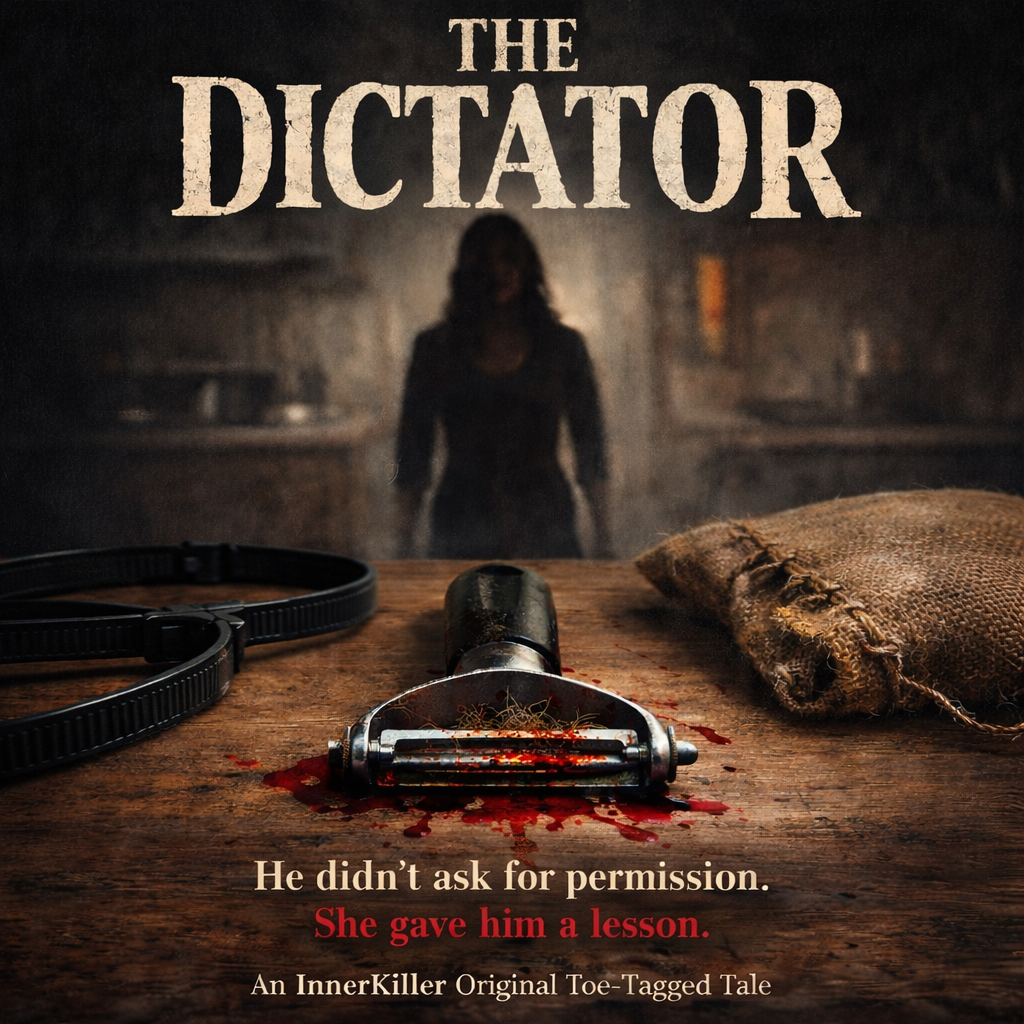
He laughed in a way that suggested he thought he understood me, and then he sat when I told him to. The hesitation was brief, but I noticed it because I notice those things. I picked up the peeler from the counter and turned it once in my hand, checking the edge without looking like I was checking anything at all. It was new, which mattered, and it felt balanced in a way that made the rest easier to control.
“What are we making?” he asked.
“Something simple,” I said.
He leaned back slightly and watched my hands, and I could see the moment when his attention shifted from casual interest to something more focused. He was still relaxed, but the edge had started to form. I stepped closer and placed my hand on his shoulder, letting the contact settle before I spoke again.
“Relax,” I said, and he nodded as if that were a reasonable request.
The first zip tie closed around his wrist with a soft, precise click, and the sound registered before the meaning did. He jerked forward and knocked his glass over, sending vodka across the table and onto the floor. The second tie followed before he could recover, and I used his own momentum to press him forward against the table. His chest hit the wood hard enough to disrupt his breathing, which helped.
“What the fuck are you doing?” he asked, and the tone had already shifted away from confidence.
I leaned close to his ear so he could feel the answer before he heard it. “I know,” I said, and I let the words sit without explaining them.
He went still for a moment, and I could feel him trying to reorganize the situation into something survivable. That part always happens, and it always fails. He started talking quickly, offering explanations that sounded rehearsed even as they came out of him for the first time.
“I didn’t do anything,” he said. “If this is about earlier, I was just messing around, and you didn’t have to...”
I placed the peeler against the back of his hand and let the metal rest there long enough for him to understand its presence. His breath changed immediately, and his body tried to pull away from a position that no longer allowed for escape. I did not interrupt him again until I was ready to begin.
“You sent it,” I said, keeping my voice level because volume would not have added anything.
“What are you talking about?” he asked, and the denial came faster now, thinner.
“The dick pic,” I said. “You wanted to be seen.”
The first pull was clean, and I watched the reaction instead of the result because that is where the truth usually appears. He screamed in a way that did not belong to the version of himself he had been presenting, and his hand tried to withdraw from his own body as if separation were possible. I maintained the same motion and pressure, repeating it with intention instead of urgency. Consistency matters more than speed.
“Stop, please stop,” he said, and the words collapsed into each other.
“She never got to say stop,” I said, and I did not expect him to understand that.
He continued to talk, shifting between apology and confusion, and none of it aligned with anything useful. I moved around the table so he could see me, and I allowed him to read my face even though it did not offer him anything he could use. His expression changed when he realized that I was not looking for an explanation. That recognition tends to arrive all at once.
“You like sending dick pics without asking,” I said.
“I didn’t mean anything by it,” he said, and he shook his head too quickly to be convincing.
I reached for his belt, and the meaning landed immediately. His body reacted before his voice did, and the chair legs scraped against the floor as he pulled against the restraints. The sound was sharp enough to settle the room in a different way.
“No, wait, please don’t do that,” he said, and the shift into pleading was complete.
“I know,” I said again, because it remained the only accurate response.
I kept my movements controlled and deliberate because speed would have made the scene feel less exact than it was. His voice filled the kitchen, but I let it pass through the room without answering it. I did not look away while he cried, and I did not alter the rhythm once it had settled. By the time I stepped back, his once shiny black pubic patch was a stained crimson ruin.
When it was finished, I stepped back and let the room settle around what I had done. He tried to pull one more breath into himself, but the effort broke apart halfway through and never reorganized. I watched his throat, then his chest, and then I pressed two fingers against the side of his neck until the last weak pulse disappeared. When I felt nothing beneath the skin, I stayed there a moment longer to make sure the stillness was real.
Later, I wrapped what I needed to keep with careful attention to detail, and I stitched the fabric closed, even though the thread did not match as well as I would have preferred. I cleaned the table, the chair, and the floor in an order that made sense to my hands before it made sense to my head. When I wrote the address, I took my time because the package mattered less than the certainty behind it. The certainty was simple now. He had wanted to be seen, and now he was dead.
At the door, I paused and looked back into the kitchen. The table had returned to being a table, and the glass lay on its side with a thin line of vodka drying into nothing. I adjusted the package under my arm and checked the seal once more.
“Return to sender,” I said quietly, and the phrasing held.
Chapter 2 — Velvet Bag
The apartment smelled like vodka, thread, and the hot metal breath of the radiator that never shut up when it should have. I stood at the sink with my sleeves rolled past my elbows, washing my hands again, even though they were already clean. The water ran cold at first, then turned lukewarm and mean, and I kept rubbing at the crease of my thumb like something had nested there overnight. It had not. That was the problem with certain kinds of quiet. They made room for things that were no longer physically present.
The velvet bag sat on the kitchen table where I had left it, dark blue once, almost gray now from years of being touched too often by one person and never by anyone else. It was small enough to fit in my coat pocket and heavy enough to change the way fabric hung when I carried it. My sister liked soft things more than she ever admitted. Even as a girl, she would run her fingers over blankets in stores and pretend she was checking the stitching when really she was imagining ownership. I dried my hands on a towel, crossed the room, and picked up the bag with more care than I had used for the package.
The phone inside was cold, harder than it looked, and the screen stayed black when I pressed the side button. I knew it would. I pressed it anyway. There was a shallow crack across one corner from the night my grandmother threw it against the wall and said nobody decent ever died over a camera. The phone had survived better than the people in the room had. I sat at the table with it in both hands and held it the way other women hold prayer when they are fresh out of better options.
I did not know the passcode. I had tried birthdays, street numbers, the name of the fish shop, our mother’s middle name, and once, in a mood I still resent, the name of the boy who first taught her to lie with a smile. Nothing opened it. The screen offered the same blank refusal every time, and I admired that about it more than I should have. Some things remained loyal long after the body failed.
I set the phone down and opened the drawer beside the stove. The peeler wrappers were folded inside in a neat stack, silver-backed and narrow as fish scales, each one slit open with my thumbnail and flattened before being kept. I told myself I saved them because they proved discipline. That was not the whole truth. There was comfort in evidence that arrived clean and left changed. I ran my finger over the edge of one wrapper until the paper gave and nicked me, then I sucked the drop away before it could stain anything.
Her voicemail was on my current phone, not hers. I kept three of them saved under fake names so nobody would ask why I never deleted old messages. The one I played most often had no important content, which made it worse somehow. She was calling to ask if I wanted anything from the corner store, and in the background, someone was laughing too loudly, and she told them to shut up with a tenderness I still cannot explain. Then she laughed too, small and embarrassed by herself, and told me to call her back before she bought dumb stuff.
I played it twice because the second listen always felt closer to punishment than comfort. On that second playthrough, I caught the tremor under her voice, slight and buried low, the kind of thing you miss if you still believe bad things announce themselves properly. I sat there with the phone against my ear and pictured her leaning against a refrigerator case under fluorescent light, deciding whether to sound normal for me or for herself. I had missed it then, and the failure still moved around in my chest like a trapped coin looking for a place to settle.
People like to say women ignore signs because they are hopeful. That has always sounded insulting to me. We ignore signs because we are tired, because rent is due, because grief is expensive before it is even earned, and because sometimes another person’s danger asks too much of your own thin skin. I missed the tremor because I was sorting invoices in the back room, thinking about bus fare, potatoes and whether my uncle had called again. That is less romantic than guilt, but guilt wears better in public.
I got up and moved through the apartment, collecting the small things that kept a shape around me. Gloves from the chair. Zip ties from the cabinet above the fridge. The burlap folded beneath the dish towels. I checked my courier bag, then checked it again, not because I had forgotten what was inside but because repetition settled me. Outside, a siren passed without slowing, and the sound pulled a clean line through the room. For a second, I saw her at twenty-two, mascara smeared, sitting cross-legged on my bed and laughing at a man who had not yet ruined her.
The laugh had changed later. That was the thing no one wrote about. Even before the pills, before the missing shifts and the hiding and the way she started wearing long sleeves in July, her laugh changed shape. It became careful. It asked permission before leaving her mouth. By the end, she sounded like a guest in her own life.
I went back to the table and picked up my phone. The local story had already started to travel, reshaped by comments from men who liked the word psycho and women who typed “good” and deleted it before posting. I scrolled past the article and opened a folder of screenshots instead. Names. Handles. Faces tilted in bathroom mirrors. Open flies. Captions sent like dares. One profile had messaged four women I knew by name and seven more I did not. He worked in River North, wore little gold chains, and had a habit of opening with the same line every time, as if repetition made it charming.
You up?
I looked at his face for a long time. He had the bland confidence of a man who had never been interrupted properly. There was a shallow scar under his chin, and a Cubs hat turned backward in three of the photos, as if age had only reached him cosmetically. I pressed my thumb to the screen until it hurt.
Then I set my sister’s locked phone beside mine and said, “Not this time.”
The radiator hissed. Somewhere downstairs, somebody dropped a pan and swore. I slid the velvet bag back over the dead phone, zipped my courier bag shut, and chose tomorrow’s route with a steadier hand than I had when I woke.
Chapter 3 — Routes
By noon, the city had already chosen its mood and decided to keep it. The wind came hard off the river and shoved at my front wheel every time I turned east, as if Chicago had opinions about where women should go when they had work to do. I kept my head down, courier bag tight across my back, and followed the line I had mapped before sunrise. Some routes were for deliveries. Some were for looking. The smart part was making them look alike.
Fulton Market liked pretending it had always been expensive. The old brick still showed through if you knew where to look, but most of the windows had been trained to behave better. Men in quarter-zips stepped out of glass offices holding coffee with foam art on top, and women with polished nails crossed streets without checking traffic because money had taught them to expect obedience from the world. I moved through them fast and ordinary, one more bike courier with chapped hands and a deadline. Nobody watched a woman sweating under a helmet unless they wanted something from her.
At the first stop, a receptionist with a face like folded paper signed for two sample cases and did not look at me again. Second, a chef in an apron asked if I had a boyfriend and laughed when I did not answer. I laughed too, because sometimes the quickest way through a moment is to dress it in the wrong emotion and hand it back. By the time I reached Logan Square, I had made six deliveries and collected three names I did not need. Men offered themselves constantly. The problem was not scarcity. It was choosing one worth the trouble.
Intersections told the truth if you stayed still long enough. Not the big ones with tourists and stroller traffic, but the ugly in-between corners where men forgot they were visible because nobody important was watching. I stopped at a red light and watched a man in mirrored sunglasses lean out of a pickup to say something to a woman walking alone, and I saw her flinch without breaking stride while he laughed as if her body had thanked him. I memorized the truck anyway, because anger could start the work, but structure always had to finish it.
That was the part people misunderstood when they talked about impulse. They thought anger chose for me. Anger started it. Structure finished it. I tracked routines, not feelings. Which blocks had cameras that worked, and which only had them for insurance? Which restaurants dumped grease too early, and which bartenders smoked out back at nine with the back door cracked? Which men repeated themselves. Repetition mattered. It turned a stranger into a pattern, and patterns were easier to live with than surprises.
I cut west toward Bucktown with an order of printer proofs strapped flat in my bag. A bus exhaled hot diesel at the curb, and the smell dragged me backward for half a second to standing outside my grandmother’s fish shop in August, sweating through my shirt, hearing my sister tell some boy on the pay phone he was stupid in a voice so sweet he thanked her for the correction. She had timing, too. Different kind. Softer on the surface. Men trusted softness because they thought it belonged to them. The light changed before I could stay with the memory long enough to ruin my afternoon.
At Damen and North, I saw him in person for the first time. The Cubs hat was backward, same as in the screenshots, though the weather did not call for it, and he came out of a juice place carrying a fluorescent green drink while checking his phone with his mouth slightly open, as if reading demanded a full-body effort. Up close, the scar under his chin looked paler than it had in the pictures, a thin white nick that almost made his face more human. Almost.
I rode past once without turning my head, then stopped on the next block beside a dumpster that smelled like oranges and bleach and adjusted the strap of my bag while watching his reflection in a dark storefront window. He did not move like a careful man. He moved like someone who had never been answered properly, checking his phone, typing with one thumb, and glancing up the street at every woman who passed as if the day had been built for his convenience. There was no hurry in him, and that helped more than caution ever could.
My phone buzzed in my pocket. A delivery update. Then another buzz, from the folder I should have muted and never did. A new screenshot had been added to the thread. Same username. Same man. Different recipient. The message was almost funny in its laziness. "U up?"
I looked from the screen to his reflection and then back again. My chest did not tighten. That would have suggested surprise, nerves, or inexperience. What I felt was cleaner than that. Something aligning. The same quiet click I had heard when the first zip tie closed, except this time it happened somewhere under my ribs.
A woman pushing a stroller stopped near him to dig for her keys. He shifted his attention immediately, smiling before she even looked up. He said something. She ignored him. His face changed for half a second, not enough to call it anger, just the insulted confusion of a man denied a response he had already counted as his. Then he laughed to himself and put the phone away, as if the moment had still ended in his favor.
Across the street, a squad car rolled through the light and kept going. He did not notice it. He stepped off the curb without checking traffic, trusting the city to pause around him the way lesser people did.
I waited until he turned north, then started pedaling again.
From behind, with the afternoon sun cutting across the block and catching the back of his neck, he looked exactly like someone who had not yet understood he was already on a route.
Chapter 4 — Unsolicited
By the time I got home, the city was inside me in small aggravating ways. My thighs still held the shape of the bike seat, and my palms had that faint buzzing ache that came after a long day of braking too hard and pretending not to rush. I dropped the courier bag by the door, kicked off one shoe, then the other, and stood in my kitchen with one sock half-twisted under my heel like a woman who still believed fatigue might count as innocence. It did not. Not in this apartment.
The laptop took too long to wake up, which made me hate it for a second. Then the screen brightened, and the room changed with it. Blue light flattened the walls, found the chipped edge of the table, and turned the velvet bag into something almost ceremonial where it sat beside the fruit bowl with two dying bananas I kept meaning to throw out. I opened the private server from muscle memory, watched the channel list populate, and felt the same small shift I always felt when the usernames came alive. Not comfort exactly. Something closer to being outnumbered in a useful direction.
The server called itself The Unsolicited, which was funnier when it had only twelve women and one locked channel for screenshots nobody wanted on their devices any longer than necessary. It had grown since then. Now there were subthreads for legal advice, burner phone recommendations, court links, emergency rides, and one room called freezer inventory that started as a joke and stopped being one in slow motion. Women posted under names like Gorechata, SoftJaw, Saint_Rot, and NoMeansNadine, and I did not know a single real name. That helped. Names made people careless.
A new upload blinked in fresh produce, and I clicked before I finished taking off my jacket. Three screenshots filled the screen, all from the same man, all sent to different women, with the same lazy opening line and the same grim little anatomy lesson offered without request. Under them, somebody had posted a cropped selfie of herself holding a butcher knife at shoulder height, chin tilted, expression bored in a way I suspected had taken practice. The replies started immediately.
One woman said he had done the same thing to her the month before. Another said he worked near Milwaukee and had been seen outside Blue Thread. A third warned that he followed women after rejection, and that line made me read the thread twice before I typed anything at all. Then I added what I knew, which was that he liked North and Damen around lunch, wore a backward Cubs hat, and carried a pale scar under his chin.
The message sat there for half a second, visible and undeniable, before the reactions started. Knife emojis appeared first, then a potato emoji from somebody who thought she was being clever, and then a private ping from Gorechata, whom I had never spoken to one-on-one and therefore distrusted on sight. She asked whether I was in Chicago proper, and I let the question sit while I clicked through her profile instead. She had no personal details, a three-month history, and just enough activity in the evidence channels to make me suspicious without giving me a reason to say why.
Before I could decide whether to ignore her, a thread opened under my route note with a blurry photo from the local news. Police tape cut across a brick alley, and the caption mentioned a possible connection to the earlier attack. NoMeansNadine wrote that men took one injury and suddenly demanded delicate language, and somebody else followed with a joke about an ex whose tires deserved to lose their will to live. I smiled before I meant to, and that was the dangerous part.
It was never just the anger in places like that. Anger was ordinary and did not need company to survive. It was the recognition that made the room feel useful, the speed with which one woman’s joke could slide through five others and land in the body like relief. I sat back in my chair and let the messages keep coming, and for one unguarded minute, I understood why people joined churches, unions, grief groups, and chat rooms with names that would look ridiculous in a court transcript. Belonging made bad ideas feel organized.
A new user entered the channel under the name Porchlight without introducing herself. She posted one screenshot, then another, then a photo of a forearm marked with half-moon nail prints that looked too ordinary to be staged and too fresh to dismiss. The room went quiet for a few seconds before the replies returned with a different kind of urgency. Women asked whether she knew him, whether she was safe tonight, and whether she needed a ride or a witness.
I stared at the forearm longer than I meant to. My sister bruised easily, and she used to cover marks with bracelets while pretending the real problem was cheap metal turning her skin green. Once, when we were teenagers, I asked why she kept dating men with hands like closed doors, and she flicked my ear and told me not to say ugly things just because I noticed them first. I still do not know whether that was kindness or training.
I typed before I had fully decided to. I told Porchlight to drop his handle and his schedule if she had it, and she responded with both, plus a note that he closed most nights alone. The channel reacted fast after that. Advice stacked, offers multiplied, somebody posted a link to public records, and somebody else claimed to know where he parked.
Then Gorechata pinged me again. She said it was funny that I was new to posting and already useful, and before I could close the window, a second message followed asking whether I was the one from the news. My hand stopped on the trackpad. Across the room, the velvet bag looked darker in the laptop glow, almost black, as if it had absorbed more than fabric should have been able to hold.
I read her question twice while the server noise kept climbing around it. Women traded screenshots, joked with knives in their profile photos, and brightened in and out of the channel list like windows in a building where nobody slept correctly. Before I could answer, a moderator tag appeared at the top of the thread with a note telling everyone to keep their eyes open because somebody in the server had started making a name for herself. That was when the room stopped feeling useful and started feeling interesting.
Chapter 5 — Skin Deep
By the time I brought him inside, the city had already stopped caring about him.
That was the first difference I noticed between this and the last time. The first one felt like an interruption. This felt like a continuation. He walked in on his own feet, talking about something that did not matter, holding a drink he did not need, filling the space with a voice that assumed it would be remembered. I let him keep talking because silence would have made him suspicious, and I was not interested in teaching him anything before it was necessary.
“You live alone?” he asked, glancing around my kitchen with a curiosity that tried to pass for politeness.
“Yes,” I said, and I handed him a glass before he could ask for one.
He took it. They always take what is offered. It saves them from having to think about what they deserve.
The burlap sack was folded on the chair behind him, placed there earlier in a way that felt accidental if you did not know what to look for. I had stitched it that morning with thread that didn't match because I wanted to see if it would bother me while I worked. It did not. That absence of irritation settled somewhere under my ribs and stayed there.
“Nice place,” he said.
“It works,” I said.
He leaned against the counter and checked his phone, thumbs moving without urgency, and I watched the small habits instead of the larger shape of him. He kept smoothing one eyebrow with the side of his thumb after every few swipes, like vanity had hardened into reflex, and he tilted his jaw toward the microwave door each time he thought his face had fallen out of place. There was a fading hospital bracelet mark on his wrist, pale against the skin, and for half a second, I wondered who had visited him there and left believing he could still become decent. People tell you what they are if you let them forget you are watching.
He checked his phone again and muttered that his sister would not stop calling him. Then he laughed to himself and said she always acted like he was the only one in the family with a car, as if picking up his niece’s prescription from the pharmacy were some private injustice aimed at him alone. He rolled his eyes when he said it, but he still looked at the screen long enough to read the message twice. The irritation in his face made him more ordinary, which was worse than if he had seemed monstrous from the start.
“Sit,” I said.
He smiled like it was part of the script. “You going to cook me something?”
“Yes,” I said.
He sat.
The zip ties felt familiar in my hands, lighter than I remembered. The first one closed around his wrist, and the sound did not startle me this time. It landed exactly where I expected it to land, clean and final. He reacted the same way the other one had, with surprise first, then confusion, then a quick reach for control that came too late.
“What the fuck—”
The second tie cut him off. I pulled him forward, pressed him down, and adjusted his arms until they aligned with the table the way they were supposed to. His chest hit the wood, and his breath left him in a short, ugly burst that I did not need to hear twice.
“Relax,” I said, and I meant it differently this time.
“I’m not— what is this?”
I did not answer him yet. I moved around the table, checked the tension in the ties, and placed the peeler within reach without looking at it directly. My hands knew where everything was supposed to go.
For a second, I saw my sister at sixteen, sitting on the freezer in the back of the fish shop with a stolen orange soda between her knees, telling me that boys only acted bold when they thought nobody would answer them correctly. The memory arrived whole enough to slow my hand before I touched the tool. I hated that pause as soon as I felt it because hesitation had no place in the room once the door was closed. Then he shifted in the chair and checked his reflection in the microwave door again, and whatever softness had tried to surface went flat.
“You messaged her,” I said.
“What?”
“You messaged her,” I repeated, and I kept my voice level because it did not need help.
“I message a lot of people,” he said quickly. “I don’t know what you’re talking about.”
“That’s the problem,” I said.
The first pull came easier.
Not faster. Easier. The motion felt settled, like it had found a groove in me that it intended to keep. I watched his reaction the same way I had before, but there was less to discover in it now. Pain looks similar across different faces. Fear too. The differences lie in the small refusals, and he had none.
“Stop,” he said. “Please stop, I didn’t—”
“You sent it,” I said.
“It was a joke,” he said. “It’s just a picture, it’s not—”
I pressed harder, not to punish him, but to keep the rhythm consistent. The process mattered. That was the only part that stayed honest.
His voice changed again, flattening out in places, spiking in others. He begged. He apologized. He tried to negotiate. I listened to all of it without needing to respond because it was not meant for me. It was meant for a version of himself that still believed this could be undone.
I moved around the table when it was time, but before I touched his belt, his phone buzzed again near the sink. The sound cut through the room with an ordinary insistence that felt wrong there. He turned toward it so fast the chair legs scraped, and his voice changed before I did anything else. “That is my sister,” he said. “She is waiting on me.”
I did not answer him at first. He swallowed, dragged in a breath that shook more than the rest of him, and tried again with a steadier voice. He said his niece had asthma and that the prescription was supposed to be picked up before the pharmacy closed. He did not sound noble when he said it. He sounded irritated that a small life still expected something from him.
I crossed to the sink, picked up the phone, and looked at the lit screen without unlocking it. Her name sat there beside two missed messages and a final text about the inhaler, the kind of domestic urgency that survives even when a man does not deserve it. I turned the phone face down and set it farther from him than before. Then I took the burlap sack from the chair and folded it neatly on the counter instead of leaving it in his sight.
When I came back to the table, he had stopped begging in broad strokes and started bargaining in specifics. He asked me to text her. He asked me to tell her the pharmacy closed early. He asked me not to leave a child waiting for medicine because of something he had done to someone he would never remember correctly. I listened to all of it, and then I resumed the sequence with the slower, colder attention I had been trying to preserve from the start.
It ended differently from the first one. He did not fight like a trapped animal once he understood I was not going to answer him. He kept trying to speak past the pain, as if practical details could still hold his body together after everything else had failed. By the time his breathing thinned into something shallow and unfinished, the room had already accepted what he had not. When I checked his pulse, I found three weak beats and then none.
I cleaned up without rushing. I wiped the table, reset the chair, and washed my hands twice before I touched his wallet. Inside, there was a folded pharmacy receipt, forty-three dollars in cash, and a narrow photo booth strip of him and a little girl making the same exaggerated fish face at the camera. I put the money back, kept the identification long enough to confirm the name, and slid the photo back where I found it because I had not come for that.
Then I wrapped what I needed to keep and stitched the burlap closed with the same mismatched thread. At the door, I waited for satisfaction, relief, or even disgust to move through me with enough force to name. Nothing answered. I adjusted the package under my arm and left the apartment with the calm of a woman who had just killed for the second time and understood that the number mattered.
Chapter 6 — The Archivist
He did not fight the way the others had, and that difference unsettled the room before anything else had time to. I had expected resistance, denial, and the usual scramble toward explanation that never arrived in time. Instead, he sat where I told him to sit, hands resting flat against the table as if he were waiting for instructions he intended to follow. His eyes moved slowly across the kitchen, not searching for exits, but observing placement and distance in a way that made me aware of everything I had already arranged.
“You can go ahead,” he said, his voice steady and without strain.
I stayed where I was and watched him more carefully. “What do you think I am going to do?” I asked.
“You brought me here for a reason,” he said. “You can go ahead.”
His tone lacked the edge I had come to expect, and that absence made it harder to place him inside the structure I had built. Most of them revealed themselves early through tension, through the way their bodies anticipated harm before it arrived. He did not. He seemed present in a way that felt deliberate rather than reactive.
“You know why you’re here?” I asked.
“I have a guess,” he said.
“That is not an answer,” I said.
“I sent things,” he said. “Pictures. Messages. I kept copies, too.”
The word copies shifted something.
“What do you mean by that?” I asked.
“I saved everything,” he said. “Not just what I sent. Other men’s messages, replies, screenshots. I organized it over time.”
“Why would you do that?” I asked.
He lowered his gaze briefly, then brought it back to me. “Because I knew it mattered,” he said. “Not to me. To someone eventually.”
The explanation did not resolve anything. It complicated it.
“You are telling me that you were helping,” I said.
“I am telling you that I was paying attention,” he said.
“That does not make you different,” I said.
“No,” he said. “It makes me earlier.”
I stepped closer and examined him with more focus than I had needed before. His skin was unmarked and untouched by anything I had done, and that absence created a different kind of pressure. I had come to rely on visible progression as a way of stabilizing the process. Without it, everything felt suspended.
“You still sent them,” I said.
“Yes,” he said. “I did.”
“And you think that keeping records explains that,” I said.
“I think it explains why I did not stop,” he said.
That answer should have simplified him. It should have made it easier to place him in the same category as the others.
It did not.
“Explain it clearly,” I said.
He swallowed once and then spoke without looking away. “It is attention,” he said. “Not just from the women receiving it, but from other men and from the structure around it. The system rewards escalation. It teaches you that the more you push, the more visible you become. I kept the evidence because I thought someone would eventually use it.”
“Use it for what?” I asked.
“For this,” he said.
The word remained between us, precise and unambiguous.
I lifted the peeler and placed it against the back of his hand, maintaining the same positioning I had used before. The metal touched his skin, and he did not pull away. Instead, he watched me with a level of attention that did not belong in this space. It was not defiance. It was not a surrender. It was something more structured than either.
“You are not afraid,” I said.
“I am afraid,” he said. “I just do not think fear is useful here.”
“It is always useful,” I said.
“Not if you are right,” he said.
The statement interrupted the motion before it could begin.
I held the tool in place and felt the hesitation register internally before it showed anywhere else. My posture remained steady, and my grip did not change, but the movement that should have followed did not arrive. It felt like missing a step on a staircase that had never failed me before.
“You think I am right,” I said.
“I think you are inevitable,” he said.
I pressed down slightly, just enough to initiate the sequence.
He flinched.
The reaction was real, but it was smaller than expected. It did not carry the same force or disruption I had relied on before. It felt incomplete.
“You do not get to agree with me,” I said.
“I am not agreeing,” he said. “I am describing the outcome.”
“Of what?” I asked.
“Of everything we did,” he said.
The word we shifted the frame in a way I did not want.
I did not move the blade forward. I held it where it was, suspended between intention and action, aware of the fact that I had stopped without choosing to. That loss of continuity mattered more than anything he had said.
“You do not get to be part of this,” I said.
“I already am,” he said.
That was the fracture.
It did not announce itself loudly or dramatically. It appeared as a small, precise break in something I had assumed was stable. The process no longer felt self-contained. It had been observed, interpreted, and placed inside a larger structure that I did not control.
I stepped back.
The peeler dropped from my hand and landed against the table with a sound that felt misplaced, as if it belonged to a different version of the room. He watched me without relief or satisfaction. His attention remained consistent, almost reflective, and that made the space feel crowded in a way I could not correct.
“You can still do it,” he said.
“I know,” I said.
“You probably should,” he said.
I looked at his hands again. They remained unbroken, unchanged, and waiting in a way that did not belong to any part of my previous experience. The absence of action carried more weight than action itself, and I could not immediately resolve it.
For the first time since this began, I did not know what the next step required.
That uncertainty stayed in place without shifting.
I remained where I was longer than I should have, aware of the time passing without using it. Then I allowed the moment to hold without forcing it forward, and I did nothing.
Chapter 7 — Leak
The notifications did not stop. They stacked in uneven bursts and made the glass on the table tremble every time the phone lit up, and I kept turning the screen face down and then back over again as if that tiny act of control still meant anything. It did not. Messages kept arriving from the server, from numbers I did not recognize, and from places that seemed to know something before I did.
I had left him tied to the chair longer than I should have, and the thought stayed with me once it arrived. When I went back, he was still there, hands unmarked, posture unchanged, and watching the door the way people watch something they expect to return. He said I was getting attention before I spoke, and when I checked the knots and the angle of the chair, instead of answering him, he asked whether I had posted something myself. I said no, and he told me I had not needed to.
The room felt smaller after that, not physically, but in the way space collapses once too many people begin to look in the same direction. I stood there for a second with the phone in my hand and the chair still between us, aware that he was reading my silence more carefully than most of the men before him had read their own danger. Then I stepped away from him and unlocked the screen again because pretending not to look had already stopped being useful.
I stepped away from him and unlocked my phone again. The server had split into threads I had not seen before, but the server was no longer the center of the problem. Someone had posted a screenshot of a local article from the Tribune metro desk, and the headline referred to a second mutilation homicide linked to the earlier killing in Fulton Market. I opened the article and read it once too fast, then forced myself to read it again.
The details were cleaner the second time. Both men had been restrained. Both men had suffered the same concentrated injury pattern. Both men had died at the scene from blood loss and shock before emergency crews could intervene. The article called the unknown offender a possible serial attacker with a repeat signature, and that phrase altered the room more than anything else on the screen.
Under the screenshot, the comments moved with a different appetite than before. Women were posting knife emojis, warnings, and nervous jokes, while men argued in public about whether a stranger’s body could ever count as a lesson. I stared at the phrase repeat signature until it stopped feeling like language and started feeling like a shape with my outline inside it. What I had built as a private system now existed outside me as a pattern other people could read.
Behind me, he said it was happening faster than I expected. I told him to stop talking, but Porchlight sent a message before the silence could settle. She wrote that someone might be logging IP addresses. I closed the app, reopened it, and checked the channel list again even though I already knew that repetition would not undo anything.
He told me I needed to cut the connection before it hardened into a trail. I asked him what connection he thought I had left, and he said the server, the routes, and anything else that turned habit into evidence. I told him I did not leave trails. He gave me a small, almost pitying smile and said, “You already did.”
I moved through it without acknowledging it, grabbing the laptop, opening settings I had not touched in months, turning things off in a sequence that felt rehearsed and incomplete at the same time. Notifications went quiet one by one, but the silence that replaced them felt louder than the noise had.
When I closed the last window, one draft tab stayed open in the corner of the screen. It held a zoomed-in still from the alley article and a cluster of comments beneath it, most of them useless, but one of them said she rides for Lake Loop. I have seen that bag before. There was no name attached to it, only a deleted-user marker and a timestamp from eight minutes earlier. I shut the laptop harder than I meant to and listened to the plastic click closed, as if it had sealed something that was already moving.
I checked the mirror above the sink, which was not something I did often enough for it to feel natural. My face looked the same as it had that morning, but the context around it had changed, and that made all the difference. I saw the outline of myself the way somebody else might see it, including the height, the build, and the way my shoulders carried tension even when I was standing still. It was enough to match a description if somebody wanted one badly enough.
I looked away, and he watched without speaking until the quiet between us became too deliberate to ignore. Then he said I was thinking about leaving, and I told him I was thinking about finishing. He answered that those things were no longer the same, and I hated him a little for being right in a tone that sounded almost gentle. Before I could respond, the phone lit again.
The phone lit up again before I could decide whether to shut it off for good. This time, the notification came from an unknown number, but it included an image instead of only text. I opened it and found a grainy photo of my building taken from across the street, with the front entrance circled in red and my bike rack visible at the edge of the frame. Beneath it, there was one line. We know where the route ends.
I did not move at first because movement would have made the threat feel more practical than it already did. Then I zoomed in and saw a timestamp in the lower corner from twenty-two minutes earlier. My stomach tightened so hard it felt mechanical. The person who sent it was no longer guessing. They had already come close enough to confirm the address.
He watched my face and understood something before I spoke. “That is the part you never planned for,” he said quietly. “You thought the city would keep you anonymous as long as you kept moving.” I looked at him, then at the door, then back at the phone in my hand. For the first time since this began, risk stopped being theoretical and became architectural.
I locked the screen and set the phone down face down again, but the image remained in me with more clarity than the room. If someone had found the building, the pattern would already have moved past rumor and into pursuit. That changed what finishing meant. It also changed what survival would cost.
Chapter 8 — Overripe
I chose him too quickly, and I knew that before he even finished the cigarette. He stood outside the bar with one hand cupped around the lighter and the other pressed to his phone, listening with the strained patience of a man pretending he was better than his own irritation. When he pulled the phone away, he muttered that he was on his way and told whoever was speaking to stop worrying because he had not been drinking that much. Then he looked up, saw me watching, and let that ordinary little responsibility slide off his face as if it had never belonged there.
“Got a light?” he asked.
“No,” I said, and I should have kept walking.
Instead, I stayed there long enough for him to mistake my pause for permission, which was the first error. He smiled with the lazy confidence of a man who thought attention had already tipped in his favor.
He told me his son hated the smell of smoke and kept nagging him to quit, and he said it in the tone men use when they want credit for being briefly observed by someone innocent. Then he asked whether I was meeting anybody, and when I said yes, he kept talking anyway. I remember that clearly because it was the part that made him specific. He was not a symbol when he followed me. He was a man with a child, a habit, and a mouth that had survived too many consequences by softening itself at the last second.
When his phone lit again, he glanced at the screen and let out a tired breath that sounded more worn than annoyed. He told me his son had a school assembly in the morning and said he still had glitter on the back seat from helping with some cardboard project that was supposed to look like a planet. Then he smiled at me in that same easy way and asked whether I had kids, as if the question itself made him gentler than he was. I remember that part because it made it harder for him to reduce without making him any easier to forgive.
That should have slowed me down. It did not. It only made the choice feel dirtier, which I mistook for urgency instead of a warning. By the time he followed me around the corner, I was already committed to motion I had not earned through structure. That was the second error, and it mattered more than the first.
Inside the apartment, the room felt misaligned in a way that was difficult to name. The table remained where it always stood, and the tools were positioned exactly as I had placed them, but the space between objects felt compressed. The room seemed to hold tension before anything had occurred, as if it were adjusting to something it did not want to accommodate.
“You didn’t answer me,” he said as he stepped further inside.
“I don’t have to,” I said.
He laughed and reached for the counter, touching it with the same careless ownership I had observed before, but this time it irritated me instead of informing me. Up close, he smelled faintly of nicotine gum and laundry detergent, and there was a worn crease in the sleeve of his jacket where somebody had mended it neatly by hand. I did not know whether he had done that himself or whether somebody patient had once cared enough to sit under a lamp and save the fabric for him. I watched his mouth anyway, the way it moved around words that did not deserve the space they occupied.
“Sit,” I said.
He hesitated longer than the others had.
“Why?” he asked.
“Because I asked you to,” I said.
He complied.
The first zip tie closed too high on his wrist, and I had to yank it back into place before locking the second one. He twisted hard enough to drag the chair leg sideways, and the scrape of wood against the floor cut through the room before I had him bent over the table. His shoulder caught the edge instead of his chest, which forced me to shove him down again and reposition his left arm with more force than skill. The mistake was small, but I felt it immediately because the room had already lost the clean sequence I depended on.
“What the fuck are you doing?” he said, and this time the question came out angry before it turned frightened.
“Stop,” I said, louder than I intended.
He kept pulling, trying to twist his hips away from the table, and I had to pin him with my forearm while reaching for the peeler one-handed. By the time I had the tool in my grip, my breathing was wrong, and his body was half out of the position I needed. The motion that followed was uneven because I was correcting him and myself at the same time, and I knew that before the first pass was even finished.
“Listen,” he said, his voice changing as he tried to regain control of the situation. “Whatever you think I did, we can talk about it…”
“There is nothing to talk about,” I said.
The first movement was uneven, and I corrected it immediately, but the mistake remained. It marked a difference that could not be undone. His reaction escalated, louder and less contained, and the sound filled the room in a way that felt excessive, as if it had been pushed beyond its intended limits.
“Please,” he said. “I didn’t do anything…”
“None of you think you did,” I said.
I increased my pace.
That decision removed the only structure holding the process together. I stopped checking placement, stopped resetting my hands, and started answering each movement of his body with one of my own, as if force could repair what sequence no longer could. He kicked once hard enough to jolt the chair off line, and I caught it badly with my knee before driving him forward again. After that, the process no longer unfolded in steps. It happened in collisions.
The burlap sack slipped from the chair and fell to the floor.
I did not pick it up.
He saw it anyway, and his reaction changed. The fear that replaced his confusion carried a different quality. It did not collapse inward. It stayed focused, directed outward, watching me instead of retreating from what was happening.
“You’re not okay,” he said.
The words interrupted something I had been maintaining.
“Stop talking,” I said.
“You’re not even doing this right,” he said, and he laughed once, short and disbelieving.
That removed the last point of restraint.
I finished it without following the steps, and that difference altered everything that came after. He fought until he could not coordinate the effort anymore, then his body turned clumsy, then heavy, then frightened in a quieter way that had nothing left to bargain with. I forced him down and stayed there until the movement left him in stages I did not bother to dignify with ritual. When I finally checked for a pulse, I found only heat and the ugly slackness that arrived after life had already gone.
The room did not settle around that death the way it had before. It felt loud, displaced, and badly arranged, as if the walls themselves had watched me abandon the procedure I had once mistaken for control. I looked at his face and saw not a target, not a correction, but a man who had been alive ten minutes earlier and had mentioned a son who hated cigarette smoke. That detail stayed where the rest of him did not. It lodged.
The burlap sack remained on the floor, folded in on itself, unused. That was when I understood the ritual had not failed by accident. I had failed it because anger had outrun structure, and structure was the only thing that ever kept the violence from swallowing the reason I gave for it. I stood there with my hands open at my sides and knew, with a certainty that felt more punishing than grief, that three dead men did not make a pattern righteous just because I could describe one.
At the door, I stopped and tried to locate the exact moment when the sequence became something else. I could not find it cleanly, which meant the break had started earlier than this room. That was worse than losing control in a single scene. It meant the fracture had entered the system before I admitted it was there.
Chapter 9 — Great Lake Silence
By the time I left the apartment, the city had already started forgetting me, and that was the first thing that felt right again. The bag was lighter than it should have been, but I did not check it to confirm why, because some absences did not need names. I locked the door without looking back, then checked it twice anyway, pressing the handle down until the mechanism clicked in a way that felt final enough to trust. After that, I got on the bike and rode east toward the lake.
Chicago arranges itself around water in a way that feels like confession. Streets run toward it whether you mean them to or not, and the wind carries the lake inland until even the buildings seem to know where the edge is. I chose the route that required the least thought and the least correction, because I no longer trusted myself to make too many decisions in a row. The phone stayed silent in my pocket, but the silence felt deliberate rather than empty.
At the shoreline, the air changed in a way the rest of the city never could. It felt colder, cleaner, and less interested in me, which was useful. I stopped where the concrete gave way to a thin line of rocks and stood there with the bike between my legs, looking at water that did not clearly reflect anything back. The surface kept moving without pattern, breaking against itself in small restless shifts that never built into anything larger.
I took the velvet bag out of my pocket and held it in both hands. Outside, it looked smaller than it did in the apartment, which surprised me more than it should have. I felt the shape of the phone inside, the cracked corner, the dead weight of something that had refused to open, no matter how many times I had asked it to. I thought about my sister laughing before she stopped laughing that way, and I told the water she could have warned me if she had wanted to.
I stepped closer to the rocks and considered throwing the bag into the lake. I did not want closure, and I did not believe in gestures, but I wanted one less object in the world that could still ask me a question I could not answer correctly. In the end, I slipped the velvet bag back into my pocket and turned away because destroying the phone would not have changed what it carried. Behind me, the city kept moving with the same insulting steadiness it had shown from the beginning.
Cars passed, people talked, and somewhere a siren rose and fell without urgency. I rode north for a while, then west, then south again, cutting through streets that did not recognize me as anything more than another body moving through them. That anonymity settled into me slowly and took the edge off the noise that had built up over the last few days. By the time I reached the next major light, I could almost pretend the city had not started learning my shape.
At a red light, I finally checked my phone. The unknown number had sent another message, but this time it contained a link to a local breaking news alert that had already been screen-captured and reposted in three places. The alert said detectives now believed the three mutilation homicides were connected and that evidence recovered from online groups and neighborhood surveillance had narrowed the search to a courier operating on the Near North and West Side routes. Beneath the link, the sender had typed only four words. You are not ahead.
I read the line twice, then put the phone away and rode the rest of the distance home without checking traffic as carefully as I should have. By the time I reached my block, an unmarked sedan was parked half a building down with two men inside pretending to look at their screens. They were not good at pretending. One of them glanced up when I stopped at the curb, and then looked away with the deliberate slowness of somebody following instructions. I kept moving because standing still would have turned suspicion into confirmation.
Inside, the apartment felt smaller than it had that morning, but not because anything had moved. The pressure had changed shape. I set the courier bag on the floor, crossed the kitchen, and placed the velvet bag in the middle of the table beside the clean peeler wrappers, the dead phone, and the identification cards I had taken and never thrown away. Then I opened the front door and left it unlocked, because by then the difference between being found and being entered had become procedural.
On the wall beside the door, I taped a sheet of paper at eye level. The handwriting stayed steady because my hand still obeyed me even when the rest of me had begun to split. “Boys, be kind. Or be peeled.” I looked at the sentence for a full second and understood that it was no longer a warning. It was evidence dressed as a slogan.
In the hallway, I could already hear movement below me. It was faint at first, just the scrape of rubber soles on concrete and a clipped voice that disappeared when the stairwell turned. Then a radio crackled once, and another voice answered with the low, controlled tone people use when they are close enough to stop whispering and not yet close enough to break a door. I stepped away from my own threshold and kept going without hurry.
I did not look back when I reached the landing, but I knew the sequence that would follow. Someone would knock once, then harder, then call out with the authority men borrow from uniforms when they need a door to surrender without argument. The apartment would open onto the table, the wrappers, the dead phone, the identification cards, and the sentence I had taped to the wall as if language could carry what ritual no longer could. By the time the first voice said “Chicago Police,” I was already moving down the next flight with my hand sliding along the rail.
At the second landing, I stopped for one breath longer than I should have. Above me, the floorboards took the weight of other people entering the life I had been arranging in private. I pictured my sister’s phone on the kitchen table beside mine, both of them silent for different reasons, and understood with a clarity I had avoided all along that none of this had ever brought me closer to her. It had only taught the city how to pronounce my grief in public.
Outside, the night air met me without sympathy. Behind me, in the apartment I had just left, my system was becoming a file, a room of photographs, and three dead men who could no longer be mistaken for rumor. I kept walking because stopping would not change what I had done, and running would not make it less mine. The city had finally learned my shape, but the only voice I wanted was still locked inside a dead phone on my kitchen table.
END
Congratulations on finishing this tale.
Your mind has traveled dark places.
Now take a moment to process, explore, and dive deeper.
Decompress Your Mind
The story may be over, but the echoes remain.
Step into our Decompression Chamber.
A space to relax, reflect, and release what lingers.
Follow Our Red ThreadBoard
Get lost in our Crime Lab.
Or click here to continue reading more Toe-Tagged Tales, blogs, and hidden connections waiting to be discovered.