UNSOLICITED
⚠️ Trigger Warning: This story may include references to Physical & Domestic Harm, Mental Health & Psychological Trauma, Sexual Violence & Exploitation, and Other Sensitive Themes involving digital abuse, coercion, and morally complex violence. Reader discretion is advised.
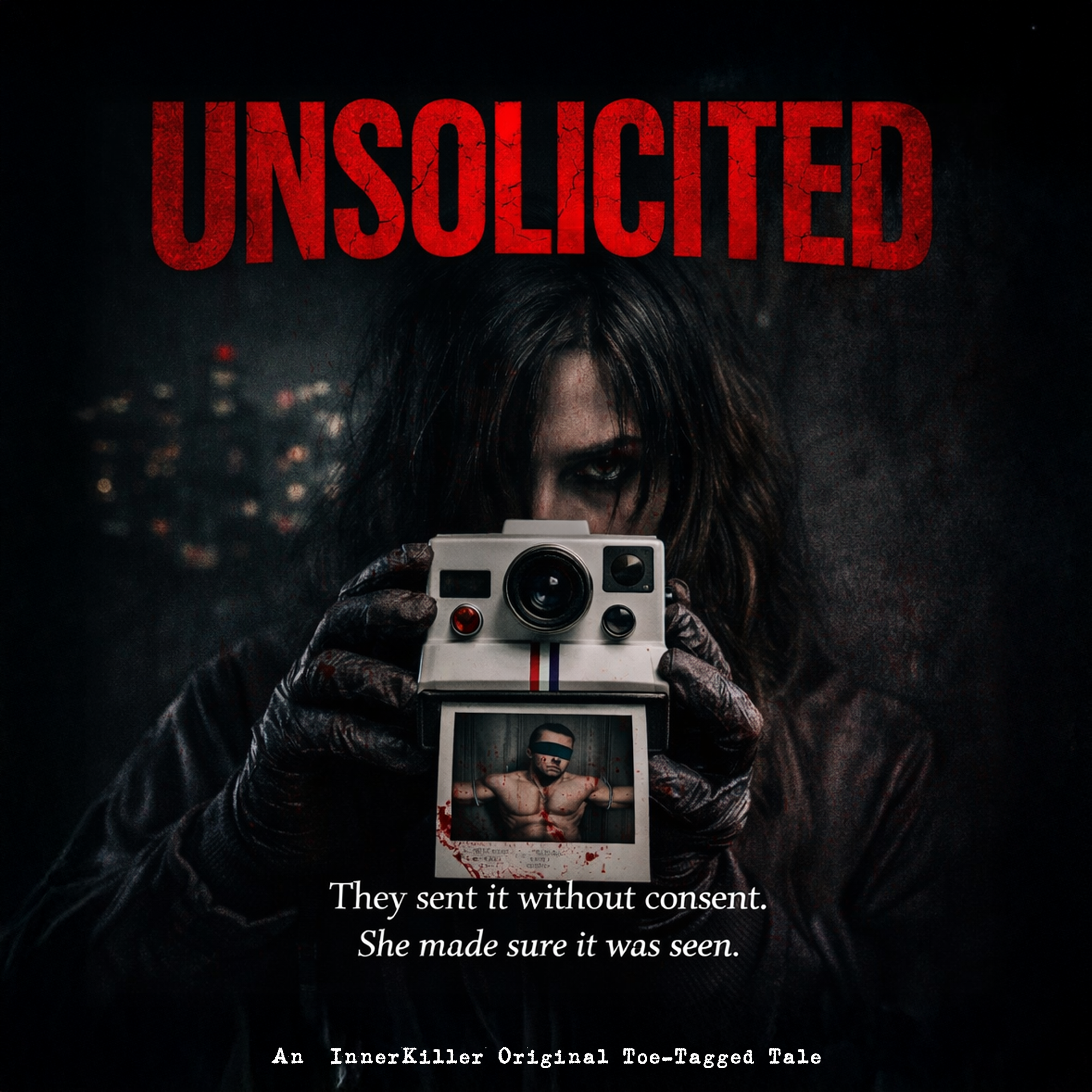
Chapter 1: Terms of Visibility
Rain made the city look soft from above, which was one of Seattle’s better lies. From her kitchen window, the glass towers around South Lake Union shimmered like things that wanted to be touched and charged by the minute. Maris stood barefoot on the heated tile with her phone in one hand and a drying Polaroid in the other, watching a man named Adrian Kessler type, delete, type again.
He had good hands for public photos. Clean watch, rolled sleeves, tasteful forearms, a wedding band gone from his profile sometime in November. He ran product for a wellness app with pastel branding and a mission statement about emotional safety. Tonight, he was sending messages from a private account with no surname attached, only a grayscale headshot and the kind of smile men practiced when they wanted to look expensive and harmless at once.
Maris enlarged the screenshot and filed it into the album labeled Aesthetic Liars. She kept the folders nested by taxonomy, not chronology. Men who opened with faux vulnerability went in one place. Men who used therapy language as a pry bar went in another. The crude ones were easy and almost boring by comparison. She preferred the polished kind. They always thought polish was the same thing as innocence.
Her apartment was very quiet except for the refrigerator motor and the little wet hiss of tires from the avenue below. On the dining table, her laptop glowed beside three stacked phones, a yellow legal pad, and the vintage Polaroid camera she cleaned more faithfully than her own mirrors. The camera wore its leather strap like a throat. She passed it on her way to the sink and touched it once with two fingers, not tenderly and not without care.
Adrian’s new message appeared.
You disappeared on me.
Not true. She had waited twenty-three minutes. Enough time to make him feel the shape of absence without letting it harden into insult. Maris leaned one hip against the counter and read the line again. Then she read the last six, all of them threaded with practiced patience, all of them carrying the same private complaint dressed in different shirts. He liked to pretend he was giving women room. What he liked was watching them hurry back to fill it.
She opened the dating app and compared his profile to the burner Instagram she had created for this version of herself. Violet Hart, twenty-nine, freelance brand consultant, faintly ironic, photographed mostly from the shoulders up. Adrian had liked Violet’s photo of an untouched martini, then sent a paragraph about how rare it was to meet someone who “understood discretion.” That word had sat in her mind all afternoon like a fishhook under the skin.
Discretion. High school had used other words.
Maris set the phone down, washed a wineglass that did not need washing, dried it, and put it back in the cabinet. When she picked up the phone again, there was another message waiting.
I figured a girl like you knew how to keep things private.
For a second, she did not move. The rain dragged a silver seam down the window. Somewhere below, a siren passed without urgency, city-shaped and tired. She took a screenshot, then another of the time stamp, then one of his profile thumbnail beside the line, because context mattered and men were always trying to wriggle out of context when it finally put its hands on them.
She saved the images under Adrian K. / Preliminaries and felt the old, familiar click inside herself. Not anger exactly. Anger was hot and often sloppy. This was narrower. A thread passing through the eye of a needle. Her grandmother used to skin rabbits in silence and talk only when the important part arrived. Clean hands first. Then supper. Maris had learned early that the body listened better when you did not raise your voice at it.
She tapped back into the chat and let her thumb hover.
Across the room, one of the burner phones buzzed with a different man, one she had already downgraded for being too obvious, too eager, too stupid to be satisfying. Another buzz came from a women’s forum where someone had posted a blurred screenshot of a corpse from six months ago and captioned it with prayer-hands emojis and a crescent moon. Maris ignored both. Adrian had moved to the center of the board without understanding he had done anything at all.
His profile was a study in careful appetites. Marathon photos. Panel appearances. A charity gala. One moody black-and-white where he stood with his hands in his pockets under a mural that said HEAL OUT LOUD. The private account told the truth faster. Models. whiskey. hotel lighting. A saved story highlight called “Unfiltered” with nothing in it now but a blank ring and the promise that something had been there once.
She typed, deleted, then typed again.
I do. That depends on whether you’re worth the effort.
The typing bubble appeared almost immediately. Men like Adrian never slept when their reflection might be speaking to them.
I had a feeling about you.
Of course you did, she thought.
He sent a second line before she could answer.
Dinner Thursday? Then somewhere quieter.
There it was. The soft arrangement. Public first so that she could feel safe. Then private, where safety would be interpreted for her by somebody with excellent teeth and a lease in a building with biometric entry. Maris could already see him checking the room for surfaces that reflected well. She could see his expensive awkwardness on the walk home, the practiced laugh, the way men like him always loosened at the exact moment they thought the script had become theirs.
She walked to the bedroom and opened the top drawer of her dresser. Beneath folded black slips and a row of silk camisoles sat the small tools of her private etiquette. Charger. Gloves. Cash. Scalpel necklace coiled in velvet. She did not touch any of them yet. This was only the second date. Ritual hated premature handling. Still, she let the drawer remain open long enough to feel the temperature change against her skin.
When she returned to the window, the city had blurred further, every tower reduced to vertical streaks of light. Adrian sent one last message, maybe because he sensed he was close to landing somewhere he liked.
No games, Violet. I want the real version of you.
Maris stared at that sentence until it stopped being text and became architecture.
Then she smiled.
She typed Thursday works and hit send. A moment later, his reply flashed up bright and eager in her hand, lighting her face from below. In the black window over Seattle, her reflection smiled back, as if receiving very good news.
Chapter 2: Rabbit Hands
Thursday arrived with the flat gray light Seattle used when it wanted every surface to look honest. Maris stripped her bed, changed the towels, and stood in the kitchen wearing thin black gloves while she wiped the counters a second time. Nothing was dirty. That was not the point. Cleanliness and readiness had never been the same thing.
The gloves fit so closely that her hands felt borrowed. She flexed her fingers, watching the matte black pull tight over her knuckles, and for a moment she was twelve again in the sink-yellow kitchen outside Austin, watching her grandmother turn a rabbit by the hind legs as if introducing it to the room. The fur had looked softer after death. That had bothered Maris more than the blood.
Her grandmother had believed in elegance the way other women believed in scripture. Lipstick before the company. Posture at the table. Knives sharpened before they were needed, never while someone was watching. She kept her hair pinned up even when gutting things, and she never hurried, which made every lesson feel permanent.
“Come closer,” she had said.
Maris had obeyed because that was the only currency her grandmother ever really respected. She remembered the rabbit’s weight, wrong for its size, and the neat way the older woman parted the pelt with two fingers before making the first incision. Not cruelty. Not tenderness either. Instruction. The kind that assumed the world would be messier than a girl deserved and expected her to learn anyway.
“Men will tell you the body is shameful when they want entrance and filthy when they want distance,” her grandmother said, sliding the skin down like a glove turned inside out. “Never let messy men teach you what a body is worth.”
At twelve, Maris had nodded because nodding was safer than questions. At sixteen, she finally understood the sentence well enough to hate how right it was.
She peeled off one glove and checked her phone. Adrian had sent a confirmation at 9:14 a.m., polished and effortless, complete with the reservation and a suggestion that they “play the rest by ear.” As if the evening were a jazz set and not a structure he expected to own by dessert. She read the message twice, then opened the hidden album on her phone and looked at the screenshots from high school she had not deleted, not really.
The old forum layout was primitive by current standards. White background. Blue links. A thumbnail that forced itself open the longer you stared. Her body had been younger in those pictures than she ever felt allowed to be. The boy who posted them had captioned one with a winking face and written, She acts shy, but girls like this always want to be seen. Three boys from algebra had commented. One from varsity baseball had asked for more. Another had typed, "Keep this private lol” as if the joke itself could bleach what he was enjoying.
Her mother had cried in the laundry room with the door closed. The principal had called it an unfortunate misunderstanding. The boy had missed two games. In the mirror above her childhood dresser, Maris had stood very still and realized stillness could feel like rot if you were left in it long enough.
Now she locked the phone and set it face down on the counter. The apartment held its quiet around her. From the living room window, the towers across the water shone dull and metallic, like instruments laid out before a procedure. She opened a drawer and checked the velvet box holding the scalpel necklace, then shut it again. Too soon. Adrian had earned anticipation, not improvisation.
In her bedroom, she chose a charcoal dress with a neckline that implied permission without giving any. She laid it across the chair and ran a lint roller over the fabric until nothing was visible. The ritual steadied her, or maybe it only arranged the unrest into straight lines. There was comfort in that. People liked to pretend comfort had to be wholesome.
When she was seventeen, the football player had cornered her after school behind the gym and told her he was sorry if she was upset. He smelled like deodorant and hot pennies. He said he had only sent the photos to one friend and things “got out of hand,” which was boy language for history arriving without a tie on. Maris remembered staring at the small acne scar on his chin while he explained her humiliation to her like a scheduling conflict.
She had smiled at him then. She had even said it was okay.
That was the part she revisited most often. Not the betrayal. Not the pictures. The smile. The way her mouth learned early that survival and performance were sisters.
The kettle clicked as it finished heating. She had forgotten she’d turned it on. Maris poured water into a mug, dropped in a tea bag, and watched the color spread slowly and brown, like bruising in reverse. Her grandmother drank coffee dark as punishment, but tea suited Seattle and its respectable little deceptions. She took the mug to the counter and opened the wooden box beside the fruit bowl.
Inside lay the letter opener.
Silver. Narrow. Balanced. A gift from an old design firm after she landed a campaign that tripled engagement. They had engraved her initials at the base, which amused her now for reasons no one at that office would survive understanding. She lifted it carefully, feeling the familiar exactness settle into her palm. It was not her only tool. It was simply the most polite.
Outside, rain began again, light enough to miss if you were already indoors. Her phone buzzed with Adrian’s name. She let it happen twice before reading. Looking forward to finally meeting the real you tonight. Maris stared at the message until something old and sour loosened, then sharpened. The problem with men like Adrian was not that they lied. It was that they believed themselves most when they were doing it. The line from the forum, the one from years ago, moved through her head with its adolescent smirk. Girls like this always want to be seen. Time changed fonts. It rarely changed appetite.
She set the mug aside. Then she carried the letter opener to the kitchen island and laid it on the counter with perfect alignment, straight and shining in the dim light, like silverware before company.
Chapter 3: Second Date
Adrian chose a restaurant that wanted to flatter everyone inside it. The lighting was low, the water arrived in sealed glass, and the servers moved with the grave concentration of people trained to make money feel intimate. When Maris stepped in from the rain, he stood too quickly, smiled too broadly, and looked relieved in a way men often did when their evening had agreed to become real.
He told her she looked better than in her pictures, then corrected himself and said "prettier," as if the revision proved character. Maris thanked him and sat across from him with the kind of calm that made men feel successful before they had earned anything. He ordered wine he pretended not to care about and asked whether she always met strangers this selectively, which was his first way of congratulating himself.
Adrian was easier to dislike in motion than on a screen. He touched the stem of his glass while he talked, then his cuff, then the edge of the table, as if every surface needed a little proof that he belonged there. He mentioned a divorce without sorrow, a product launch without humility, and a sister in Portland who had just had a baby girl and refused to move back to Seattle because, as he put it, “she likes living where men still know how to act.” Maris hated him a little for that sentence, then hated herself a little for noticing that when he spoke about the baby, he smiled without calculation.
When the server brought the check folder by mistake, Adrian thanked her by name even though she had not introduced herself again. He said his mother had waited tables through nursing school and once told him that men who snapped for attention should be left thirsty on principle. The line might have been borrowed, but the softness in his voice when he said mother was not. Maris watched that small decency pass through him and felt, for an instant, the nuisance of a man refusing to stay singular.
By the second drink, he had settled into the version of himself he trusted most. He talked about discretion the way other men talked about kindness, as if privacy were a favor women should feel lucky to receive from him. When Maris asked whether he always sounded this rehearsed, he laughed and told her that honesty only sounded scripted to people used to games.
Then he said, “Women never say what they really want. They circle it until you say it for them.”
The sentence landed clean. Not theatrical. Not loud. It carried the same old theft in a more expensive suit. Maris held his gaze just long enough to make him think he had been provocative instead of ordinary, then finished the last of her wine and asked if he wanted one more drink somewhere quieter.
The walk back through Belltown felt damp and almost civil. Adrian offered his umbrella and kept angling it toward her shoulder, a gesture so practiced it had stopped belonging to weather. On the elevator ride up, he checked his reflection in the brushed steel when he thought she was looking at the floor numbers. Maris watched his throat instead and wondered when men first learned that vanity could pass for softness if it stayed well-groomed.
Her apartment did exactly what apartments like hers always did to men like him. It made them careless. Adrian turned slowly in the living room, taking in the skyline, the muted lamps, the camera on the credenza, the expensive restraint of everything. He said the place was beautiful and then added that she did not seem like someone who should live alone, which was how men like Adrian turned admiration into occupation.
Maris took his coat and hung it by the door. She poured bourbon into two glasses at the kitchen island and watched his eyes move over her hands when she slid one toward him. He thanked her, toasted discretion with a smile, and drank too fast for someone who wanted to be read as controlled. That pleased her more than it should have.
He came closer after that in tidy stages. His hand settled at her waist, then moved lower with the quiet entitlement of somebody checking whether refusal was going to be inconvenient. Maris let him kiss her once. He kissed like a man trying to be praised for the effort he had mistaken for generosity.
“Bedroom?” he asked.
She shook her head and said, “Here is fine.”
That answer lit something in him. He set down his glass and reached for his belt with the private ease of a man stepping into a scene he had already decided belonged to him. He gave her a crooked little smile, looked down at himself with a sense of ownership, and began to unzip.
That sound was always smaller than it deserved to be. Metal teeth separated. It sounded like a permission slip written in a language men assumed the room already spoke. Adrian looked up at her then, not tender and not vicious, simply certain, and all the old words moved through her at once. Girls like this always want to be seen. I figured a girl like you knew how to keep things private. Women never say what they really want.
Maris moved before thought could make a mess of it.
Her left hand caught his wrist. Her right hand brought the letter opener up fast and low, the blade entering where the body had forgotten to be polished. Adrian made a sound of offended confusion before pain taught him accuracy. He staggered backward, one hand jerking toward the wound, the other grabbing uselessly at the edge of the island while his face tried to rearrange itself around what had happened.
Maris stepped in and guided him down instead of letting him crash. That part mattered to her more than she liked admitting. The bourbon glass toppled and shattered near the baseboards. Adrian tried to say Violet, then tried again as if the right name might change the scene, but the room had already moved past names.
“Shh,” she said.
He folded onto the tile and looked up at her with something that finally resembled honesty. Without the smile, without the cuff links, without the vocabulary he used to manage other people, he was only a frightened man bleeding in a beautiful kitchen. For half a breath, she saw the sister in Portland again, the baby girl, the version of him that probably knew how to hold something small without ruining it. Then the thought passed, and the body remained.
The apartment grew very quiet around the soft, ugly work of blood finding level ground. Maris stood still until she could feel her own breathing change. The sensation was not joy exactly. It was narrower and cleaner than that. The world, for one impossible minute, had stopped misnaming what was happening.
She crossed to the credenza, took the Polaroid into both hands, and came back to him. Adrian’s head had turned slightly toward the windows, where the skyline kept glittering as if nothing beneath it ever learned consequence. Maris adjusted his shoulder, lifted the camera, and carefully framed him.
The flash broke the room open. The white square slid out into her waiting fingers. Then the kitchen darkened again, and all she could hear was the slow, patient sound of blood hitting tile.
Chapter 4: UNSOLICITED
Adrian looked better once he stopped asking the room for forgiveness. The panic had gone out of his face in uneven stages, leaving behind something flatter and more accurate. Maris crouched beside the body with the Polaroid in one hand and studied the angle of his jaw, the open collar, the way death had ruined his self-management without making him grotesque. She preferred that. Disorder was useful. Sloppiness was amateur.
The photograph developed slowly in her grip, his features surfacing beneath the white like a memory dragged up by force. Maris set it on the island and moved back to the body, stepping around the dark spread on the tile with care that would have looked maternal from the wrong distance. She rolled Adrian onto his back, adjusted one shoulder, and smoothed the front of his shirt where his own hand had bunched it during the worst of it. By the time she stood, the room had become legible again.
She fetched the second camera from the hall closet, the digital one she used for precision rather than devotion. The Polaroid was for possession. The digital files were for structure. Maris shot Adrian from above first, then lower, then from the side, where the city lights caught his face and made him look almost contemplative, which irritated her enough to correct it by shifting his chin with two fingers.
His phone was still in his jacket pocket by the door. She retrieved it, unlocked it with his face while the body was still warm enough to cooperate, and immediately turned off biometric access. The private account came first. Then the hidden photo folder. Then the message threads full of women bent into categories he would have called chemistry, connection, timing, and confusion. Maris exported what mattered to an encrypted drive, tagged three screenshots, and sent a timed release to a dormant account she used only when a man had cultivated a reputation as a hedge against consequence.
The ritual improved her breathing. Killing was a sharp thing, bright and irreversible, but the staging had architecture. It rewarded patience. It answered every humiliating sentence with sequence, framing, and a degree of authorship no one had ever offered her when it was her body caught in the wrong hands. By the time she went to wash the letter opener, she felt calmer than she had all week.
The water ran hot over her gloves, then hotter over her bare hands when she stripped them off. In the mirror above the sink, her face looked almost blank except for the eyes, which never fully cleared after. Euphoric during. Voidlike after. The language from the profile she might have written about herself if she were stupid enough to be clinical. Maris dried the blade, wrapped it in a dish towel, and set it aside before returning to Adrian with a small office stapler and the first Polaroid.
She cut away enough fabric to expose what she needed. Not crudely. Not with anger. Ceremony hated tantrums. Adrian’s body had become heavy in the intimate, inconvenient way all bodies did once they stopped participating, but she had planned for that. She placed the Polaroid where it belonged, stapled it in place with two quick presses, and stepped back to read the image against the flesh.
Then she took a black marker from the drawer and wrote across the white border in clean block letters.
UNSOLICITED.
The word steadied her. It was plain enough to survive contact with anyone. No poetry yet. Poetry came later, once the evidence had teeth. She photographed the label from three angles, then opened the notes app on a burner phone and drafted the caption she would use for the anonymous upload: coordinates, timestamp, a title, nothing more indulgent than necessary. Men always over-explained themselves. She refused to die sounding like one.
The QR code took the longest. She printed the adhesive stencil from a pocket thermal printer, pressed it against Adrian’s thigh, and traced the shape into the skin with shallow, deliberate cuts meant to mark rather than mutilate. It would link to nothing for now. A dead blog carried more mystique than a live one, and anticipation was part of punishment. By the time she peeled the stencil away, the code sat there neat and square, a private door disguised as damage.
At 2:11 a.m., she uploaded the selected image set to the art blog under a retired alias, stripped the metadata, routed the post through three countries, and scheduled its public visibility for exactly seventeen minutes. Long enough to spread. Short enough to blur certainty. She tagged the post with geographic coordinates and a caption that made her smile despite herself.
Terms accepted.
Then she cleaned. Glass first. Countertops. Tile edges. The bourbon spill. The prints he had left where he touched the island, the back of the chair, and the bathroom tap he had used without asking. She bagged his watch, his phone, the napkin with his mouth on it, and the broken pieces of his evening in separate freezer bags labeled in small, tidy script. When she finally straightened, the apartment smelled faintly of bleach and expensive cologne, losing the battle.
The post went live at 2:28.
Her phone vibrates once against the table, a soft, familiar interruption that feels almost out of place in the room. The contact name reads Mom, and the message arrives with a photo attached, a dim image of a casserole dish beside a chipped blue bowl Maris recognizes immediately. The text asks whether she has been eating properly, as if care can still cross distance without distortion. Maris types a response, deletes it, then tries again and deletes that too because both versions sound like someone who still belongs somewhere. She finally sends a thumbs-up and leaves the phone face down, then keeps her hand resting on it longer than necessary because the quiet that follows feels chosen rather than earned.
Maris sat at the dining table with Adrian’s phone, one burner, and her laptop open in front of her, watching the numbers climb. Views first. Then reposts. Then comments, some horrified, some thrilled, some trying to pretend they did not know exactly what kind of image they were looking at. Three minutes in, a private notification appeared from a women-only forum she did not post in but sometimes read when insomnia made her curious.
The message came from a user named glassrabbit.
The label is cleaner this time. Queen Anne again?
Maris stared at it long enough for the shape of her own pulse to become distracting. Cleaner this time. Again. There was no public this time, no public before, not in any form that should have allowed comparison. She clicked into the profile. No photo. No history visible. No location. Just a blank icon and a join date from eight months earlier, old enough to feel patient.
The blog analytics kept rising in the corner of her screen. She should have shut everything down and started the body removal timeline. Instead, she opened the post one last time and watched the counter refresh itself, each number a stranger leaning closer to the glass.
“Seen by 4,392.”
Chapter 5: The Women in the Walls
She did not move Adrian until dawn began pressing its diluted light against the windows. The delay irritated her, which was how she knew the message had lodged deeper than she wanted to admit. Cleaner this time. Queen Anne again. Maris had replayed the sentence so often it now seemed to exist in the apartment as a sound rather than a thought, tucked into the vents, crouched behind the bookshelves, waiting for her to pass.
By eight, Adrian was gone in pieces of process if not yet in fact, and the apartment had resumed its cultivated innocence. Maris stood in the bathroom wearing a robe and watched herself remove mascara with the concentration of someone dismantling evidence molecule by molecule. Her face in the mirror looked intact. The problem was that it no longer felt hers exclusively.
At work, the office in South Lake Union was all pale wood, wellness slogans, and cold brew on tap. A woman from content strategy asked how her Thursday night had gone, and Maris said, “Quiet,” which was true in the way shallow graves were quiet. She sat through a product meeting about user trust signals and consent-forward onboarding language while three browser tabs lay hidden beneath the presentation deck on her laptop. One tracked mentions of the anonymous art post before its deletion finished propagating. One tracked police chatter and neighborhood traffic cams. The third stayed open to the women’s forum.
By lunch, the image was gone from the open web. That part had worked. What remained were afterimages. Screenshots on gossip threads. A blurred repost on a private channel with the caption Whoever she is, she’s making men careful. Someone else had copied the typography of Maris’s label and turned it into a meme. UNSOLICITED in black capitals over stock photos of smug men leaning on kitchen counters. Ugly. Reductive. Fast.
Then she saw the first real violation.
A user called saintviolet had posted a collage of men’s cropped torsos, each one overlaid with a white rectangle in the exact Polaroid position Maris used. The caption read: Now you see them. Hundreds of replies sat beneath it, many laughing, some confessing private revenge fantasies, some speaking in the careful, half-joking dialect women used when they wanted to reveal hunger without being held to it. Maris scrolled farther and found another post from a different account, this one sharing a photo of a bathroom mirror cracked into neat segments, with a QR code drawn in lipstick in the corner.
She felt it low in her throat first. Not fear. Not pride. Something meaner and more intimate than both.
The women’s forum had always been a place she skimmed with detached appetite, collecting trends, learning how rage disguised itself when women had to make it social. Today it felt different. Crowded. The pages moved with a hush she could almost hear, each screen full of women talking around her without knowing they were touching the edge of something alive. A thread titled "If she’s real, she’s not wrong" had 3,000 replies. Another titled Seattle girls had been locked by moderators and reopened twice.
Maris clicked back into Glassrabbit and found a new message waiting.
You left the right thigh cleaner than the left. Better lighting this time, too.
She sat very still.
That detail had not been in the upload. The cropped images never showed enough of the thigh to compare surfaces, and no public comment had mentioned the lighting except to call it artful, which made her want to break someone’s fingers. She opened the user profile again, then the source code, then the hidden layers available through the forum shell. Nothing. The account was ghost-clean. Not amateur clean either. Intentional.
A memory rose before she could refuse it. She was sixteen, standing in the girls’ bathroom at school while three girls pretended not to stare at her reflection in the mirror. One had asked whether the leaked photos were really meant for her boyfriend. Another had smiled into the sink and said, “At least the lighting is flattering.” Humiliation was rarely original. It just got new hardware.
Maris closed her laptop too hard. The woman in the next cubicle glanced over the partition and asked if she was okay. Maris smiled without showing teeth and said she had a migraine. Half an hour later, she was back home, shoes abandoned at the door, forum tabs open again across all three burner phones like a private infestation.
The posts multiplied when watched. That was the unnerving part. A woman in Toronto uploaded a screenshot of a man begging to explain himself, then captioned it with coordinates to a steakhouse and the words terms accepted. A college student in Phoenix posted a photo of scissors, white tape, and a printed QR code with the comment for aesthetics only, relax. Somebody had even created a thread called Local Chapters and filled it with fake chapter names, city roll calls, and half-ironic pledges to “make the inbox sacred again.” It should have amused her. Instead, it felt like mold finding the wall behind a painting.
Maris opened her encrypted drive and reviewed the archived images from prior kills, each one framed and labeled according to standards no one else had earned. She had told herself the work mattered because it was precise, because it spoke where women were usually told to swallow, and because someone had to answer men in a language they respected. Looking at the cheap imitations crawling across the forum, she understood something uglier. It was not enough that they were using her idea. They were using her voice badly.
She clicked into the oldest folder and let the thumbnails line up in rows. Seattle, Tacoma, Bellevue, Portland, San Jose. Fifteen men stared back at her in different clothes and different rooms, all flattened into the same final grammar of light, flesh, and correction. Adrian had not started anything. He had only become the cleanest recent entry in a pattern old enough to have its own muscle memory.
The final message from glassrabbit arrived at 4:43 p.m.
There was no greeting, no build, only a single line and an attached image. The image showed a mirror broken into six clean shards. Reflected inside them was a woman’s hand holding a Polaroid camera. Not Maris’s hand. Not her camera. But close enough to feel invasive. Beneath it, the message read:
“Thank you for teaching us how to answer.”
Chapter 6: A Woman Looking Back
The broken mirror photo stayed open on Maris’s laptop long after the screen dimmed around it. Six shards, six little rooms, one hand holding a camera that almost knew what it was doing. She sat at the dining table in yesterday’s robe with the city blurred beyond her windows and had the sharp, humiliating sense that someone else was already inside the apartment with her, not in body, but in method.
By noon, the image had been copied to three encrypted folders, two burner phones, and one offline drive she kept inside a hollow design annual on the bookshelf. That should have calmed her. Duplication usually did. Instead, each version made the hand look more familiar, the angle more deliberate, the fracture lines in the mirror more like a diagram than damage.
At work, she kept her headphones on without music. The office glass carried reflections from every direction, conference room walls layered over laptop screens, smiling coworkers ghosted into the windows behind her. During a brand review, she caught her own face in the dark strip of a monitor and had the strange feeling of being watched from inside it. She smiled anyway when someone complimented her deck revisions. Women learned early how to keep performing while the floor shifted beneath them.
At noon, her manager stopped by her desk and asked whether she could join a client lunch after all because the client trusted her face in difficult rooms. Maris said yes before she had time to resent how quickly the answer came. For forty minutes, she sat under pendant lighting and explained tone strategy to a founder who kept using the word authenticity like a product feature. When he thanked her for making the room feel safe, she smiled with perfect teeth and felt the old nausea rise anyway, because safety had become the expression she wore when she needed distance most.
At 2:17, a link began moving through the forum threads.
Not public. Not quite hidden either. Just one of those local news segments women passed to each other when the anchor looked too pleased with himself and the facts had started to sweat. Maris clicked it from the restroom stall, sound low, and watched a reporter stand outside a brick precinct in a camel coat while a lower-third graphic read: DIGITAL VIGILANTE OR STAGED PANIC? Beside him, half-obscured by rain and another camera operator’s shoulder, stood a woman in a charcoal overcoat speaking to a uniformed officer with one hand tucked under her elbow.
Maris paused the video.
The woman was not glamorous enough for television and not casual enough for city bureaucracy. Early forties, maybe. Dark hair cut above the shoulders. No visible wedding ring. She held still in a way that suggested effort rather than ease, as if the body had once been taught to take up less space and later refused. When the clip resumed, the reporter said her name only once, quickly and almost reluctantly.
Dr. Lena Sorrell, consultant in cyber-behavioral threat analysis.
Maris replayed the segment twice more. Lena never faced the camera directly. That made her more interesting. When the reporter tried to ask if the imagery suggested a sexual motive, Lena looked past him to the patrol cars reflected in the precinct windows and said, “I think people keep mistaking display for desire.” Then the clip cut back to the anchor before she could finish the thought.
Maris felt something small and ugly move under her ribs.
She found Lena within fifteen minutes. Public university bio. A guest lecture on digital coercion and reputational harm. A panel appearance after a sextortion case two years ago. An essay in an academic journal with a title so bloodless it almost hid the wound inside it: Humiliation as Networked Control. In the author photo, Lena looked even less television-ready, all hard attention and tired eyes, like a woman who had spent too many years sorting pain into categories because categories were the only containers that did not leak.
At the bottom of the faculty page sat a campus office number and a contact email. Nothing else. No husband in a holiday photo. No dog. No cheerful evidence of a life performed online. It irritated Maris immediately.
That evening, Lena appeared again, this time in a forum post, a clip from a podcast preview. Someone had captioned it she gets it. Maris watched the preview, standing at her kitchen counter with the letter opener in one hand and a cooling mug of tea in the other. The host kept trying to drag the story toward sex, toward kink, toward the sort of lazy pathology that let men file women’s violence under appetite and move on. Lena let him talk until he embarrassed himself.
“Whoever is doing this,” she said, “is not primarily chasing arousal. She is curating an audience.”
The host laughed in the wrong place. “That sounds theatrical.”
“It is authored,” Lena said. “That is different.”
Maris set the mug down too hard. Tea sloshed over her knuckles, hot enough to sting. She barely noticed.
Authored.
No one had used that word except the voice in her own head, and even there it arrived rarely, because naming a thing too clearly often cheapened it. She paused the clip on Lena’s face. The woman was looking at the host, but not really. She was looking through him, beyond him, as if he were only another pane of glass between her and the structure behind it. Maris hated her a little for that. She hated her more for being right.
The apartment darkened early under the rain. Maris opened a burner account and drafted a message to Lena’s university email. It was careful at first, written in the voice of a graduate student researching digital shame. Then she deleted it and tried again as a survivor, asking whether women ever stopped feeling public once it happened. That version made her pause longer than it should have.
She suddenly and against her will saw the laundry room in her childhood house after the photo leak. Her mother was standing with one hand over her mouth, staring into the metal lid of the washing machine because it was reflective enough to punish and dull enough to survive. Maris had not gone in. She had listened from the hallway and thought, with the clean cruelty of teenagers, that grief looked ugly on older women. Now, years later, she wondered whether ugliness had simply been what pain looked like without an audience to flatter it.
She wrote a third draft.
This one said almost nothing. Just a line about the forum imagery, an authorship question, and a closing sentence that felt too naked the moment it appeared: How do you tell the difference between being understood and being found? Maris stared at it until her own face rose faintly in the black border of the screen, floating over the words like a bad omen.
Her burner phone vibrated before she could close the mail window. For one irrational second, she thought Lena had answered, but the message came through the forum instead, posted by a moderator account that had never contacted her before. The pinned notice announced that Dr. Lena Sorrell would be hosting a closed digital harm session for verified users the following week, with one line included beneath the event link in plain text. If the original poster is present, you are not invisible just because your face is not attached. Maris read the sentence twice, then locked the screen hard enough to hear the plastic snap under her thumb.
Then, for the first time, she deleted the draft before posting it.
Chapter 7: Beta Tested
The idea comes to her too fast to be careful.
That is how she knows it is wrong.
Maris stands at her kitchen window with Lena Sorrell’s paused face still ghosting the black glass behind her. The word authored sits in her throat like something she cannot swallow or spit out. The city feels closer tonight, not quieter, just more available. Every lit window reads like a screen she has not opened yet. She picks one man out of the skyline without meaning to, then another, and the selection begins to feel like practice instead of judgment.
By midnight, she has already changed the plan twice.
The target settles on Daniel Rourke because he has the kind of reputation that resists accusation. He moves through venture capital, philanthropy, and panel discussions, where he says the word "accountability" as if it belongs to him. His name appears in three archived threads she has not touched yet, always near the same kind of women, always followed by silence that reads like legal containment. He sends his first message from a private account within six minutes of matching.
I have seen you around. You are selective.
Maris smiles at the phrasing. Men like Rourke always assume they are discovering something rare instead of recognizing a pattern they helped build. She answers faster than she should. She feels the deviation immediately, a shift in tempo that sharpens the night instead of stabilizing it.
They skip the public space.
That is the second deviation.
Rourke suggests a drink in his car before anything more formal. He calls it efficient, as if intimacy were something he could schedule between obligations. Maris agrees because she wants to see what efficiency looks like when it fails. She chooses the location instead of him, a quiet overlook above Queen Anne where the city stretches out beneath them like a map of permission.
He arrives in a dark sedan that smells faintly of leather and citrus cleaner. The interior lighting is soft enough to flatter him. He is older than Adrian, better at holding still, and less interested in pretending he is not already getting what he wants. He does not reach for her immediately. That makes him more interesting. It also makes her impatient.
When he unlocks his phone to silence a notification, Maris sees the wallpaper before he turns the screen away. A little girl stares back from the glass, wearing swim goggles and grinning through a mouthful of missing teeth, both hands raised as if she has just won something private and enormous. Rourke notices her looking and gives a short, almost embarrassed laugh. He says his daughter still thinks he can fix anything with enough money and a weekend. Then he smiles again, the public version sliding back into place, and whatever softness had surfaced in him seals over like a habit.
The wallpaper had unsettled her, but it was not the reason she had kept Daniel Rourke on her screen. Two weeks earlier, she had pulled a badly buried complaint from an investor archive, half-redacted and quietly settled, in which a junior founder described being kept in a parked car after a fund-raiser while Rourke explained that panic damaged women faster than men damaged them. He had not threatened the woman in the document. He had done something cleaner and more expensive than that. He had offered her strategy, discretion, and a payment path that treated humiliation like a branding issue. When he smiled at Maris now, she recognized the same voice dressed in better lighting.
“You look like trouble,” he says.
“You look like a man who thinks that is a compliment,” she answers.
He laughs and hands her a glass from a small travel kit in the center console. She does not drink it. He does. She watches his hands instead, the way they rest without hesitation, the absence of nervous movement, the quiet ownership in how he occupies the seat. Men like him do not need to rush. They assume the room will follow.
For a moment, something flickers. It is not doubt. It is something thinner and more inconvenient. He has not said anything explicit yet. He has not reduced her with language. He has only assumed proximity, which is worse in a quieter way. It would be easy to assign him the same sentence she has used before. She waits.
He fills the silence.
“I like women who do not perform innocence,” he says. “It wastes time.”
There it is. Clean enough to pass. Maris feels the internal click, but this time it arrives with something beneath it that feels like momentum rather than certainty.
She leans closer. He turns to meet her, and for a brief second, they are reflected together in the dark glass of the windshield, their faces overlapping the city behind them. The image steadies her in the wrong way.
“Show me what you do not waste,” she says.
The unzip is quieter in a car.
It sounds contained, almost polite, like a door opening in a space that does not expect witnesses. Rourke does not rush it. He watches her while he does it, as if the attention itself is part of the exchange. Maris watches his eyes instead of his hands. That is new. She does not like it.
She moves anyway.
The blade goes in clean.
Not the letter opener. Too familiar. She chose something smaller, flatter and easier to conceal along her sleeve. It enters low and at an angle, guided by a precision she no longer has to think about. Rourke’s breath catches, but he does not collapse immediately. He blinks at her as if recalibrating the scene rather than resisting it.
“You,” he says, almost conversational.
Maris presses closer and braces his shoulder as his body begins to fail in increments. The car fills with the small, private sounds people make when control leaves them. She feels the heat of him through the coat, the expensive fabric becoming irrelevant under her hand. For a moment, she sees the wallpaper again, the girl in goggles, the version of him that existed outside this seat.
Then it passes.
She guides him sideways across the leather, careful with angles, careful with light. The city burns quietly beyond the windshield. Lena’s voice moves through her head again, the word authored turning sharper with each repetition.
She works quickly.
Too quickly.
The camera comes out before she has fully positioned him. Not one camera. Three. The Polaroid, the digital, and the handheld she has been testing for low light. She moves through angles faster than she should, capturing him from the driver’s side, then the passenger seat, then the back, each image slightly off from the last. She adjusts his head once, then stops correcting. Imperfection reads as movement. Movement reads as life.
She labels the Polaroid without hesitation.
UNSOLICITED.
The word lands more heavily this time. It feels less like a message and more like ownership.
The QR code is rushed.
That is where the mistake enters.
The stencil slips when she presses it to his thigh. She notices. She corrects. She decides it is close enough. Close enough has never been part of her ritual. Tonight it is. She tells herself the variation adds texture. She tells herself no one will see it. She tells herself enough things to keep moving.
By the time she finishes, the car smells wrong.
Metal and citrus and something warmer underneath it all. She wipes what needs wiping, leaves what needs to be seen, and steps out into the rain with her coat pulled tight around her body. The city air feels thinner than it should. She breathes it anyway.
At the curb, she realizes the passenger seat is pushed too far back.
It is a small mistake, the kind that shows up in photographs and asks questions nobody planned for. She opens the door again and leans in, adjusting it with two quick movements. Her reflection catches in the rearview mirror, pale and sharp under the dome light, unfamiliar in a way she does not like. A bus rolls past at the end of the overlook, and below them a traffic camera turns slowly toward the wet street.
She closes the door harder than necessary.
The upload goes live before she is home.
No delay. No staging window. Immediate.
Three angles. Three versions. One caption.
Beta tested.
She watches the numbers climb from the back seat of a rideshare, the driver’s reflection cutting across her screen at every stoplight. Views spike faster than before. Comments arrive in clusters. Shares multiply before the first scanner thread even catches the location.
Maris leans her head back against the glass and closes her eyes for a second.
For a moment, she feels something close to completion.
It disappears before she can hold it.
By morning, the city is already talking about the image before it knows the name attached to the body.
Chapter 8: The Wrong Man
The next target arrives already carrying the wrong temperature.
Maris feels it before he speaks. Not innocence. Not safety either. Just an absence of the usual heat, the easy little steam of entitlement men brought into rooms when they believed wanting was a form of permission. He stands in her doorway with rain on his shoulders and a face she recognizes from a profile she almost discarded for being too careful.
His name is Owen Slate. Thirty-eight. Crisis PR. Recently divorced. A private message history clean enough to look curated, except for one line that hooked her three nights ago and would not let go: Some damage only looks accidental from far away. It was not explicit. It was not crude. It was worse than both because it sounded like someone writing toward a wound rather than around it.
He steps inside without scanning the apartment the way most men do. No inventory of shelves, no flicker toward the bedroom, no smug appreciation of the skyline she lets people mistake for intimacy. He notices the camera on the credenza, then her. In that order. Maris closes the door and feels, against her will, the mildest lift of interest.
“You look disappointed,” he says.
“You look rehearsed,” she answers.
He smiles, but it does not settle into place the way other men’s smiles do. It moves through his face like weather rather than branding. She takes his coat, hangs it near the door, and leads him toward the kitchen where she has already prepared the glasses, the softened lighting, the measured distance between invitation and trap. The apartment looks beautiful tonight. That annoys her suddenly, as if beauty might count as help.
Owen declines the bourbon at first. Then he changes his mind and takes it neat. He does not drink right away. He turns the glass once in his hand and looks out at the city.
“I used to date a woman who worked in death care,” he says. “She told me the worst rooms are the ones that look calm after something happened in them.”
Maris leans against the counter. “That sounds like a line you save for second dates.”
“It usually works better,” he says.
The answer should make him easier. Instead, it opens him a little and leaves her with nothing clean to sort. She studies his profile as he speaks, the mouth, the throat, the signs she relies on. There are traces of damage in him, but not the kind she hunts. Not obviously. She does not like the word obviously anymore. It has started to feel naive.
He asks almost nothing about her. That should make him safer, but it doesn’t. It feels like a man leaving a chair empty on purpose.
“I saw the coverage this morning,” he says after a while, still looking at the glass. “The consultant woman. Lena Sorrell.”
Maris does not move.
“She has a good face for bad news,” he adds. “Like she expects the truth to be uglier than the room can handle.”
“You watch a lot of local news for a man who pretends to be interesting.”
He laughs softly. “I watch women who know what rooms are for.”
The line lands somewhere deep enough to bruise. Not because it flatters. Because it sounds adjacent to understanding, and adjacency has always been the more dangerous thing. Maris takes a slow sip from her own glass and tastes almost nothing. She is aware of her pulse now, which rarely happens this early.
He sets his drink down untouched.
“I almost wrote to her once,” he says.
“To the consultant?”
“To the version of myself that thought being understood would fix anything.”
Maris looks at him then, fully. There is no performance in his face she can name. No obvious cruelty. No eager private appetite waiting for the room to grow softer. He seems, if anything, tired in a way she distrusts. Men wore exhaustion like sainthood now. They dragged their tenderness into women’s homes and expected credit for not breaking anything immediately.
She steps closer anyway.
That is her mistake.
She lets her fingers touch his wrist first, then the inside of his coat sleeve, then the front of his shirt. A normal progression. A familiar route. He does not seize it. He only watches her with the attention of someone standing very still near water, not afraid of falling in, not eager either. When she kisses him, he kisses her back gently enough to feel almost impolite.
“Not what you expected?” he asks against her mouth.
Maris answers by guiding him toward the window. The skyline throws their reflections back at them in layers, her face over his shoulder, his mouth near her temple, the room doubled and tripled in the glass. She reaches for the blade hidden in the cushion seam of the bench without breaking the kiss. Her body knows the timing. Her mind does not. It lags a half-second behind, asking the wrong question too late.
What if he is not for this?
The blade comes free anyway.
Owen’s hand closes around her wrist before the angle is complete. Not violently. Precisely. He looks down between them, then back at her, and whatever he sees in her face makes something sad move through his own.
“There you are,” he says.
Maris jerks back hard enough to break them apart. The blade nicks his palm instead of entering where it should. Blood beads instantly, bright and ordinary. He does not flinch from it. He only keeps hold of her wrist a second longer than necessary, then lets go as if releasing something breakable.
Maris does not move right away. The room holds in a way that feels almost merciful, as if the moment is offering her a version of herself she has not yet committed to. She thinks about leaving without touching him, about letting the night collapse into something unfinished that no one could name. For a brief second, she imagines a version of her life where nothing needs to be corrected because nothing is claimed in the first place. Then she looks at him again and feels the old calculation return, clean and practiced, and understands that stopping would not undo anything that made her necessary.
“You knew,” she says.
“I knew someone was answering men like they were messages that could not be unsent,” Owen says. “I used to clean up stories like this for men who could afford the right language. Not bodies. Reputations. A photo leak, a complaint, a woman named too early and doubted too long. I told myself I was containing damage when I was really teaching men how to survive consequence.”
“How?” she asks. Owen glances toward the Polaroid camera on the credenza, then back at her. “Because nobody uses the word worth that way unless an older woman taught it first,” he says. “My grandmother skinned rabbits, and my ex-wife used to say that girls who got exposed learned to smile before they learned to hate it.”
The sentence strikes low and wrong. Not a connection. A contamination.
“You think you are correcting them,” she says, and the words feel thinner as they leave her mouth. Owen shakes his head once, not dismissively, but with the quiet certainty of someone who has already followed the thought further than she has. He says correction implies something intact enough to restore, something that existed clean before it was broken. He says what she is doing feels closer to translation, except the language shifts every time she uses it, bending toward whatever outcome she needs to believe. Maris feels the distance between those ideas open beneath her, and for a second, she does not know which version of herself is speaking.
Maris moves before either of them can say anything else. She drives him backward with more force than precision, tries to recover the angle, tries to turn the scene back into something legible. Owen catches her forearm this time, and the two of them hit the side table hard enough to send the camera lurching. It falls, flashes accidentally, and spits out a white square that skids across the floor between them like something embarrassed to exist.
That should have been the pivot into ritual. It should have been the moment the room surrendered its shape.
Instead, Owen stumbles away from her with blood on one hand and disbelief on his face, and Maris stands there breathing too fast, blade low at her side, unable to decide whether to finish him or flee the fact that he is looking at her with recognition instead of terror. The photograph develops slowly on the hardwood at their feet.
Her own reflection appears in it first. Then part of his shoulder. Then nothing clean enough to use.
Chapter 9: Now You See Me
The room does not recover.
Maris feels it immediately, the way a space holds damage even after the motion stops. Owen stands across from her with blood working slowly down his hand, and the Polaroid between them continues developing like it does not understand it has failed. Her face is in it. Not fully. Not cleanly. But enough to register.
That has never happened.
She steps toward it before she realizes she is moving. Owen watches her, not with fear and not with urgency, but with something worse, a steady attention that does not flinch away from her even now. It makes the air feel thin in a way the room cannot hide.
“You should leave,” she says.
He does not.
“That is not how this ends,” he answers, his voice quieter than it should be.
Maris bends, picks up the Polaroid, and feels the image settle under her thumb. Her own eye stares back at her from the grain, slightly warped by the angle, but undeniably hers. She turns it once, then again, as if the orientation might erase what has already happened.
“You came here for me,” she says.
“I came here because I thought I recognized the pattern,” he says. “I did not expect to recognize the person.”
The word person lands wrong. It strips the structure out of her. For a second, she sees herself not as author, not as correction, but as something simpler and more fragile, a woman holding a blade in her own kitchen with a stranger’s blood drying on the floor. The thought irritates her enough to move.
She closes the distance.
This time, she does not wait for the right moment. She drives forward, blade angled higher, faster, without the ceremony she has trained into herself for years. Owen reacts, but not like the others. He does not plead. He does not freeze. He steps in, not away, catching her wrist again, turning the movement into something closer, more entangled than either of them planned.
They collide against the counter.
The camera falls a second time. The digital one skids across the tile and bumps against the cabinet, its lens pointed upward. The small handheld remains in her coat pocket, pressing cold against her ribs like a reminder she does not want. Owen’s grip tightens, then slips as the blood on his hand betrays him. Maris feels the opening and takes it.
The blade finds him.
Not clean.
Not precise.
It enters where it can, not where it should. Owen’s breath leaves him in a short, surprised sound that does not belong in this room. His eyes meet hers, and for the first time, there is something like fear there, but it is tangled with something else she cannot name fast enough to reject.
“You are not done,” he says, and the words feel less like a warning than a diagnosis.
Maris pulls back. The movement is wrong. Everything is wrong now. The rhythm is gone, replaced by something jagged and immediate that refuses to settle into ritual. She should guide him down. She should correct the angle. She should restore the scene.
She does none of it.
Owen stumbles against the counter, one hand braced, the other failing to contain what is already moving through him. The apartment sounds different with him still standing, still speaking, still looking at her like she is not finished, but unfinished.
“Stop,” he says, not as an order, not as a plea. “Just stop for a second.”
She almost does.
For a brief moment, she imagines setting the blade down and opening the door instead of closing it again. The thought arrives without structure, not a plan but a sensation, like remembering a version of herself that still believed movement could lead somewhere other than repetition. She can almost feel the hallway air, the weight of leaving without finishing anything, without correcting anything. The image holds long enough to register as possible before she dismisses it with deliberate force, folding it back into the part of herself that does not survive contact with what she has already done.
That is the fracture.
For a breath that lasts too long, Maris stands there with the blade low at her side and watches him exist inside the damage instead of becoming it. She sees the line of his mouth, the effort it takes him to stay upright, the stubborn refusal to collapse into something simpler. It breaks the pattern in a way she cannot correct.
“I do not need you to understand,” she says, but the sentence arrives thinner than it should.
“I already do,” he answers.
The certainty in it is unbearable.
Maris moves again, not toward him this time, but away. She grabs the handheld camera from her coat pocket and lifts it without thinking. The lens catches both of them in the reflection of the window, her face sharp and lit, his body offset behind her, the city burning through the glass like a second audience.
For a second, she sees it.
The image she has been building toward without admitting it. Not the bodies and not the labels, but the presence. The proof that she exists inside the frame instead of behind it. It feels dangerous. It feels necessary.
She presses the button.
The flash fills the room.
Owen flinches, not from the light, but from the timing of it. When it fades, he looks smaller somehow, less anchored to the version of himself that walked through her door. He sways once, then steadies, then fails to fully recover. The blood has done what it does, regardless of intention.
“You should go,” she says again.
This time he listens.
Not because she has control. Because he understands something she does not. He moves toward the door in uneven steps, leaving a line behind him that she will have to decide how to interpret later. At the threshold, he turns once, not dramatically, not as a final look, but as if confirming something already known.
“You are going to make this worse,” he says.
Maris says nothing.
She heard him hit the hallway wall before she heard the elevator call button. Then came a wet cough, a pause, and the ugly scrape of a man trying not to die in a building with thin late-night acoustics. Maris stood still with the blade in her hand and counted the seconds between sounds until she lost count and had to start over. When the elevator finally arrived, its bell chimed once, bright and domestic, and the quiet afterward felt worse than the noise.
The door closes. The apartment inhales around her. The silence that follows is not empty. It is crowded with everything she has broken out of sequence. She stands there for a long moment, then looks down at the camera in her hand.
Her face is in it.
Not partial. Not accidental. Fully.
Her hand started shaking only after the stillness had nowhere else to go. Blood from Owen’s shirtfront had streaked the edge of the island, the cabinet pull, and one pale thread of the dish towel she had used on Adrian, and seeing that old order contaminated by new mess made something in her turn feral and stupid. She wiped one spot, then another, then stopped halfway through because the smear looked worse and because somebody on the floor below had opened a door and said hello into the hall, loud enough to make the whole building feel suddenly inhabited.
She pressed the heel of her hand against her mouth and bit down hard enough to taste iron that did not belong to him. For one ugly second she wanted to throw the camera through the window, then the burner phone after it, then every polished object in the apartment that had ever helped her pretend control was the same thing as safety. Instead, she stood there breathing too fast in a room that had begun to look borrowed, as if someone harsher and less disciplined had broken in wearing her face.
She does not clean.
She does not stage.
She does not correct.
Her phone lights up again before she reaches the chair, not with a forum notification this time but with a number she does not recognize. She watches it ring once, then stop, then ring again immediately, more insistent. When she does not answer, a voicemail appears without delay, and the transcription begins writing itself across the screen in broken fragments she cannot stop reading. This is Detective Hale with Seattle PD. We need to speak with you regarding a digital artifact that appears to contain your image. The message cuts off mid-sentence, but it does not need to finish. Maris stands there with the phone in her hand and understands, with a clarity that feels almost clean, that the frame has already moved beyond her.
She pauses at the counter and looks at the black marker she used earlier, the same one still resting beside the island where the first word was written clean and controlled. For a moment, she only holds it, feeling the weight of something that used to belong entirely to other bodies. Then she lifts her shirt just enough to expose her skin and writes the word in the same block lettering she gave him, steady despite the tremor she refuses to acknowledge. The ink drags slightly at first, then settles into clarity as her hand adjusts to the curve of herself instead of someone else. When she finishes, she does not look down immediately.
Instead, she walks to the window with the burner device in one hand and the marker still uncapped in the other. The glass has gone black enough to return her reflection cleanly, but the city still burns through it in thin, distant points that make her look layered rather than singular. She opens the camera and lets the screen light her from below while unread notifications gather across the top edge, small and pale and insistent. When she lifts the device, her body, the word on her skin, the window behind her, and the reach of other people all settle into the same frame.
She hesitates once.
Then she posts without caption, coordinates, or explanation. The omission feels less like restraint than certainty, because the image no longer needs language to do its work. By the time the upload bar clears, the room has already rearranged itself around the fact of what she has released.
In the frame, her face is lit by the burner screen and doubled in the black window behind her. UNSOLICITED lies stark across her skin, while the city and the first unread notifications ghost faintly over her body as if the audience has already entered the image with her. It is the only picture of herself anyone will ever be certain is real, and the first one that does not belong to her alone.
Chapter 10: Watch Yourselves
The image spreads before morning finishes deciding what it is.
Maris does not watch it happen in real time. That would have been her before. That would have been the version of her who believed control required witnessing every stage of the consequences. Now she sits on the floor with her back against the kitchen cabinets, the camera beside her, the apartment still wrong around her, and lets the world take her face without supervision.
Her phone vibrates once. Then again. Then it does not stop.
She ignores it for twelve full minutes. She counts them in the quiet between vibrations, the way her grandmother used to count breaths between cuts, letting the body tell you when it was ready for the next instruction. When she finally looks, the image has already fractured into copies.
Different crops. Different captions. Different truths.
Some accounts post her face with reverence. Some distort it into something monstrous, stretching the grain until her eyes look wider and easier to hate. Others stamp UNSOLICITED over her image as if the word belongs to her now instead of the bodies she placed it on. The comments are worse than the images. They always are.
She reads three.
Then she stops.
Across the city, people begin adjusting themselves.
A man in a high-rise apartment opens a message thread, types something that has worked for him before, then deletes it. He looks at his own reflection in the glass and tilts his phone down like the angle might save him. Another man in a rideshare scrolls past the image twice, then locks his phone without liking or sharing it, as if silence could function as distance.
In a dorm room two states away, a girl screenshots Maris’s face and sends it to a friend with a single line: She did it. The friend replies with a heart, then deletes it, then types something longer and does not send that either. The hesitation moves faster than the image. It spreads in ways that leave no trace.
Maris eventually stands.
The apartment resists her less now, or maybe she has stopped asking it to. She walks to the sink, washes her hands, and watches the water run clear without believing in what that means. The small cut on her thumb from last night stings under the heat. She presses it once, just to feel the boundary of her own body still responding to pressure.
Somewhere around eleven, two police cars rolled into the street below and sat there longer than parked traffic ever should. Maris saw one uniformed officer step out and look up at the building with the bored patience of somebody waiting for a resident manager to find the right key. She moved back from the window too fast, struck her hip against the counter, and laughed once under her breath because the sound that came out of her did not belong to a woman in control of anything.
A minute later, the intercom buzzed once and then again. Maris froze with her hand still braced against the counter and let it ring out without answering. Through the speaker came the muffled voice of building management asking residents on the upper floors to confirm whether they had heard any disturbance overnight. When the line clicked dead, the apartment felt less like a refuge than a room waiting to be correctly named.
Her email refreshed before she could step away from the counter. Building management had sent a grainy still from the hallway security camera to every resident on the upper floors, asking whether anyone could identify the injured man who entered the elevator at 11:43 p.m. The image was blurred, but not merciful. Owen’s shoulder was turned toward the lens, one hand pressed hard to his side, and the mark beside the call button looked dark even through the pixelation. Maris deleted the message, emptied the trash, and stared at the blank screen because none of those motions changed the fact that the building now possessed a version of the night that did not need her face to find her.
The news picks it up by noon.
They use a blurred version of her face at first, then a sharper one when the network decides the risk is worth the attention. The anchor’s voice stays steady and professional, the same tone used for storms, elections, and public tragedies that come with disclaimers. Behind him, the image sits larger than it should, her eyes fixed on something the viewers cannot see.
Lena Sorrell appears again in a split-screen.
This time, she faces the camera.
Maris turns the volume up.
“What we are seeing now is not escalation,” Lena says. “It is transfer.”
The host leans forward, eager, misunderstanding already forming in his mouth. “Transfer of what, exactly?”
“Of authorship,” Lena says. “The image removes anonymity and replaces it with instruction. It changes the question from who is she to what does she allow.”
The host tried to steer her back toward motive, but Lena did not follow him. She looked directly into the camera and said that if the woman behind the image was watching, she should assume the city was already collecting hallway footage, ride histories, and time stamps she once trusted more than people. Lena added that authored violence always left an administrative trail, even when the body was moved or the post was deleted. Then she said, with quiet certainty, that the most dangerous point in any pattern came when its maker mistook recognition for control. Maris tightened her hand around the remote before she realized she had risen from the couch.
Maris watches her without blinking.
The phrasing lands clean. Too clean. It strips away the parts Maris has been using to hold herself together and lays something flatter underneath. Not a myth. Not a monster. A permission structure. She feels the shape of it settle into the space she left open when she posted the image without a caption.
She thought suddenly of the archived folders on the encrypted drive, each city arranged under the next, each man reduced to proof that a pattern had already outlived any single body. Fifteen finished files. Two recent killings that the news could still smell. One wounded man somewhere beyond her building walls, carrying her mistake through the night. The number did not comfort her. It only made the room feel more crowded with versions of herself she could no longer put back in order.
Her phone buzzes again.
This time she answers.
Not with a call. With a login.
The forum has changed.
Threads have multiplied overnight, splitting into smaller rooms, each one carrying a version of her image, her language, her posture. Some women speak carefully, as if afraid to be overheard by the wrong kind of attention. Others move faster, more certain, repeating phrases that sound like hers but no longer feel like hers.
A new thread sits at the top.
Watch Yourselves
She clicks it.
Inside, there is no image. No caption. Just a series of posts, each one describing a moment that did not happen, or did, or might. A man deleting a message. A woman choosing not to respond. A hand hovering over a send button, then pulling back. The language is stripped down, almost clinical, like instructions disguised as confession.
Maris scrolls.
At the bottom, a new post appears while she is looking at it.
No username she recognizes. No history attached.
Just a single line.
We don’t need to see you anymore.
Her breath catches once. Not dramatically. Just enough to register.
For the first time since the image went live, she feels something like absence open under her feet. Not loss. Not fear exactly. Something quieter. The removal of a center she has been standing in without noticing how much it held.
She closes the app.
The apartment feels larger now. Or emptier. The difference is not useful.
Maris walks to the window and looks out at the city. She imagines her face multiplied across glass and screens and eyes that will never meet hers.
She raises her hand and presses it lightly against the window.
Her reflection meets it from the other side.
For a second, she thinks about taking another photo. About correcting the last one. About reclaiming the frame before it dissolves completely into something she cannot direct.
She does not move.
Somewhere below, a man unlocks his phone and opens a message he has already decided not to send. He reads it once, twice, then deletes it with a thumb that hesitates longer than it used to. Somewhere else, a woman watches the typing bubble appear in her own thread and begins writing before it resolves.
END
Congratulations on finishing this tale.
Your mind has traveled dark places.
Now take a moment to process, explore, and dive deeper.
Decompress Your Mind
The story may be over, but the echoes remain.
Step into our Decompression Chamber.
A space to relax, reflect, and release what lingers.
Follow Our Red ThreadBoard
Get lost in our Crime Lab.
Or click here to continue reading more Toe-Tagged Tales, blogs, and hidden connections waiting to be discovered.